


AI Is Writing Code Faster. Why Is Software Still Taking So Long?
The development tools changed. The operating model didn’t.
“The Code Is Ready. The Release Isn’t.”

Project Manager: “Is the feature ready for release?”
Developer: “The code is ready.”
QA Lead: “Not yet. The workflow doesn’t match the latest acceptance criteria.”
Developer: “When did the criteria change?”
Business Analyst: “During Tuesday’s stakeholder meeting.”
Tech Lead: “Was the updated requirement reviewed before development?”
Business Analyst: “It was captured in the meeting notes.”
Developer: “But was it updated in the ticket?”
Business Analyst: “No. I thought the notes had been shared.”
There it is.
The requirement changed. The meeting captured it. But the ticket, design and development work continued with the earlier version.
Nobody deliberately ignored the process. Everyone completed the task assigned to them.
The Project Manager aligned with the stakeholders.
The Business Analyst documented the discussion.
The Tech Lead reviewed the available design.
The Developer built what was in the ticket.
The QA Lead tested it against the latest expectation.
Every person did their job.
The context simply stopped moving between them.
This is where many software delivery problems actually begin not inside the code, but in the gaps between conversations, decisions, teams and systems.
A requirement may begin in a stakeholder meeting, continue through an email and finally appear as a ticket. A later clarification may stay inside a meeting transcript. A design decision may live in a separate document. A developer may work from the approved ticket without knowing that the business expectation has already changed.
The mismatch may only become visible during testing.
By that point, the team has already invested time in analysis, design, development and review. What looks like a QA problem is often a context problem that started much earlier.
Now introduce AI into the same workflow.
The Business Analyst creates requirements faster.
The Tech Lead prepares the design faster.
The Developer produces code faster.
The QA team generates test cases faster.
But if each stage is working from a different version of the truth, the organization has not removed the problem.
It has only reached the problem faster.
That is why the next phase of AI in software development cannot be limited to helping people complete isolated tasks. The larger opportunity is to connect the entire journey-from the first business conversation to the final release.
AI Is Already Moving Faster Than the Workflow Around It
The discussion around AI in software development has changed remarkably quickly.
A few years ago, organizations were asking whether developers should use AI. Today, many are deciding how widely it should be used, what information it can access and how its outputs should be reviewed.
The 2025 DORA research found that 90% of technology professionals now use AI at work, while more than 80% believe it has increased their productivity.
But the research also found something every technology leader should notice: higher AI adoption was associated with both increased delivery throughput and increased delivery instability.
Teams may be producing more. That does not automatically mean they are releasing more reliably.
GitHub’s survey of 2,000 enterprise software professionals found that more than 97% had used AI coding tools at work at some point. More than 98% said their organizations had experimented with AI-generated test cases.
AI adoption is clearly no longer a future possibility.
But adoption alone does not equal transformation.
Imagine a developer who can complete a task in two days instead of five. On paper, the productivity gain is clear.
But what if the completed work then waits:
- Two days for a requirement clarification
- Three days for a technical review
- Four days for QA validation
- Another week for final approval
The development task became faster.
The business outcome did not.
The delay simply moved to another part of the workflow.
This is the challenge now facing the industry. AI is accelerating the work performed within individual stages, but the handoffs between those stages often remain manual, disconnected and dependent on someone remembering to update the right system.
The meeting summary may be generated instantly, but someone still needs to turn it into an approved requirement.
The design may be drafted quickly, but the right technical owner still needs to review it.
The code may be generated in minutes, but it still needs to reflect the approved design and business expectation.
The test cases may appear immediately, but they are only useful if they validate the right intent.
The release notes may be automated, but the organization still needs confidence that the work is complete, reviewed and ready.
This is why faster output is only part of the story. The more important questions are:
Did the right context reach the right stage?
Did the right person review it?
Can the team explain why the work changed?
Can the final release be connected to the original business decision?
Without those answers, AI may increase activity without increasing confidence.
The Real Journey Begins Before the First Line of Code

Software development is often discussed as if it begins when a developer starts coding.
Businesses know differently.
A software feature may begin when a customer describes a recurring problem.
A platform change may begin when an operations team identifies a delay.
A system integration may begin when two departments discover they are manually entering the same information.
Long before code is written, the organization is already making decisions that will shape the release. Someone must understand the need.
Consider a simple business request:
“Customers should be able to complete the approval process without leaving the application.”
It sounds clear. But the Business Analyst may still need to ask:
Which customers?
Which approval process?
Who has the authority to approve?
What happens when a request is rejected?
Does the action require an audit record?
Should the customer receive a notification?
What information can be displayed during the process?
If those questions are not resolved, the Developer must either pause the work or make assumptions.
AI can help identify the missing questions. It can review meetings, messages and approved documents to bring relevant context together. It can prepare structured requirements and show where each decision originated.
But the business owner must still confirm:
“Yes, this accurately represents what we need.”
That confirmation matters.
The same principle applies to the technical design. AI may prepare an initial specification, identify affected systems or recommend an implementation approach. But the Tech Lead must still determine whether that approach fits the organization’s architecture, security requirements and operating environment.
Only then should the work move into development.
This is not about adding unnecessary approvals to every task. It is about placing human judgment at the moments where an incorrect assumption becomes expensive.
The model is simple:
AI prepares and advances the work.
People approve the decisions that carry responsibility.
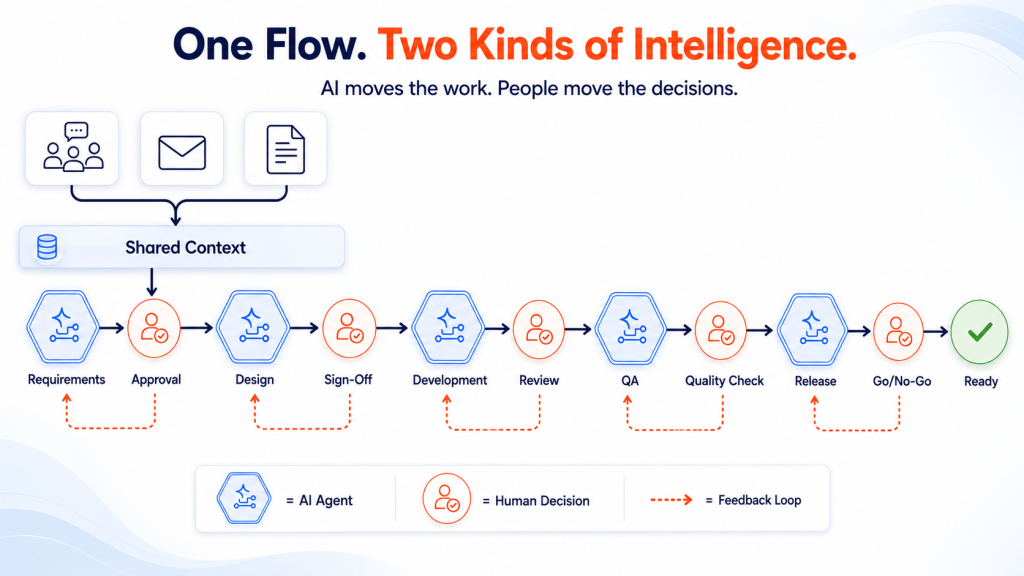
GitHub COO Kyle Daigle described the human opportunity behind AI adoption:
“AI doesn’t replace human jobs-it frees up time for human creativity.”
In the software development lifecycle, it should also free people to focus on judgment – less time reconstructing conversations, converting notes into requirements, searching for the latest version, or filling gaps with assumptions.
Faster Code Is Only the Beginning
Relatable, right?
The requirement changed. The ticket didn’t. The code moved forward. QA found the gap.
AI can accelerate every stage. But someone still needs to connect with the business expectation, the technical execution and the people responsible for the outcome.
That is why Forward-Deployed Engineers are becoming increasingly relevant. Working closely with business and delivery teams, they help translate AI capabilities into workflows that reflect how the organization operates.
Because if teams are moving faster but releases are not, the answer may not be another tool. It may be the way work moves between them.
See How Value Health Simplifies AI-Accelerated SDLC for Healthcare