


You tap “Start.”
The app knows where you are, what you need, and what should happen next. No repeated information. No searching through multiple screens. No uncertainty.
Now imagine that experience for a patient starting a complex treatment.
Behind the scenes, pharma teams need to coordinate patient information, support services, and multiple partners.
What if the technology could adapt to the patient support program instead of forcing the program to adapt to the technology?
The access maze
Managing a patient support program involves more than supporting individual patients. Pharma companies must balance operational costs, resource allocation, service partner coordination, and consistent support across multiple products and programs.
As patient volumes grow, teams face increasing pressure to manage program requirements, coordinate providers and specialty pharmacies, maintain visibility into performance, and deliver timely patient support.
When information is scattered across systems and teams, it becomes harder to control costs, measure performance, and scale operations efficiently.
The challenge is to grow patient support without growing operational complexity at the same pace.
More than a CRM
A conventional CRM helps manage information and relationships. But patient support programs need more than contact records and case tracking.
They need a platform built around their specific requirements.
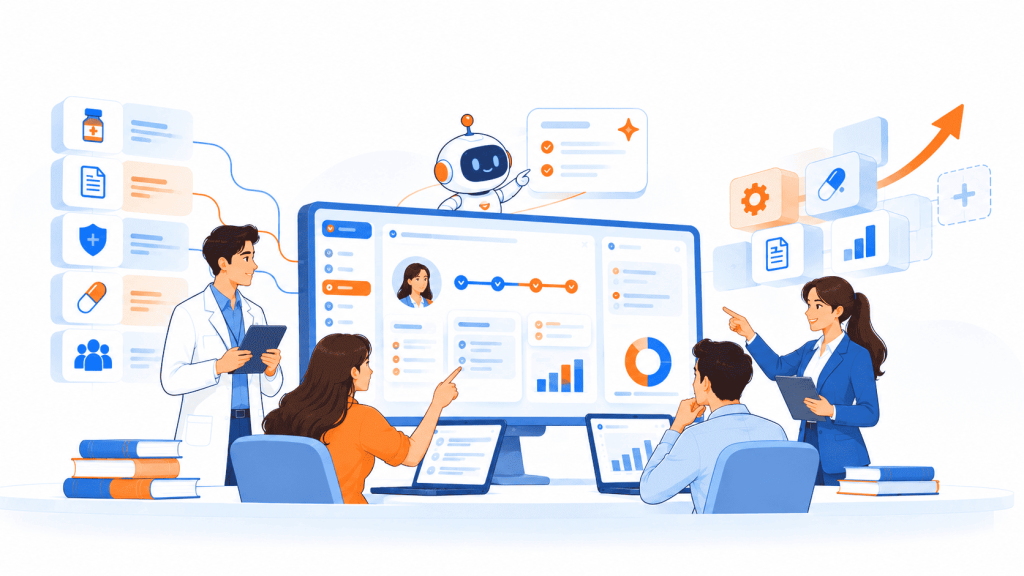
A PSP-centric, tailor-made Patient Services CRM brings patient, case, task, and program information together. It helps teams understand where cases stand, identify missing information, assign responsibilities, and determine what needs attention.
Instead of asking, “What happened to this case?” teams can focus on:
“What needs to happen next?”
From manual work to meaningful action
A custom-built Patient Services CRM can help reduce repetitive tasks and manual effort through:
- AI-powered automation: Extract information, summarize cases, identify missing data, and recommend next steps.
- Automated task management: Improve task ownership and reduce repeated follow-ups.
- Scalable configuration: Update form questions, modify business rules, adjust report fields, and validate program parameters to accommodate changing requirements without rebuilding the platform.
- Connected patient services: Support enrolment, benefits verification, prior authorization, financial assistance, case management, and adherence.
- Operational visibility: Track cases, monitor performance, and identify delays that need attention.
The goal is not simply to digitize existing activities. It is to help teams manage patient services with greater clarity and less manual effort.
A CRM stores information. A PSP-centric platform helps turn that information into action.
Built to fit today and Scale for tomorrow
Patient support programs evolve. Patient volumes increase, new products launch, eligibility requirements change, and service partners grow.
A custom-built Patient Services CRM gives organizations the flexibility to adapt without rebuilding their entire system.
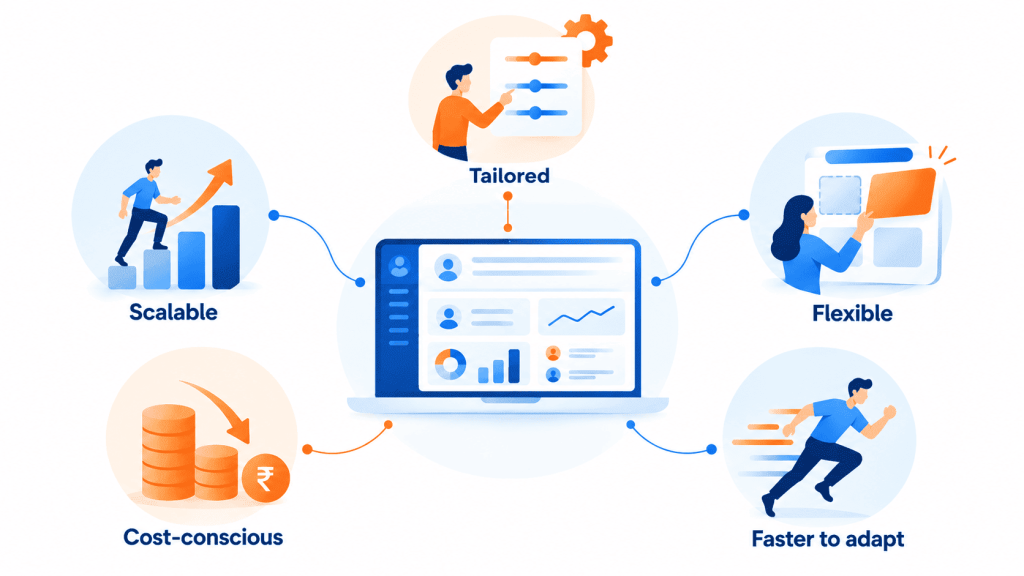
Tailored: Configure the platform around your program, patient journey, and business requirements.
Scalable: Invest in the capabilities your program needs today, with the flexibility to scale as your portfolio grows.
Flexible: Adapt forms, rules, reports, and other capabilities as requirements change.
Cost-conscious: Avoid heavy platform licensing costs and align technology investment more closely with program requirements.
Faster to adapt: Use prompt-led configuration and pre-built components to simplify changes as your program evolves.
Build for today. Scale for tomorrow. Adapt as your program grows.
More human support, less process chasing
Automation is not about replacing human support. It is about reducing repetitive work so teams can focus on complex cases and meaningful patient conversations.
AI agents can help extract information, summarize cases, identify gaps, and suggest next steps. Teams can then use their experience and judgment where personal attention matters most.
Research on AI-based adherence interventions has reported improvements ranging from 6.7% to 32.7% in specific studies, although results vary by intervention and patient population.
“Building technology for patient support starts with understanding how programs run. We bring that expertise into the technology we build, so pharma teams can adapt their operations as their programs grow.”
-Neil Raja, CEO, Value Health
By connecting patient access, affordability, care coordination, and engagement, a tailor-made Patient Services CRM can help pharma teams, providers, HUBs, specialty pharmacies, and field teams work from a clearer, more coordinated foundation.
Because patient access should not feel like a maze.
It should give pharma teams a clearer path from program requirements to coordinated patient support.
Discover how Value Health’s custom-built Patient Services CRM can help simplify patient support operations, reduce manual work, and keep every patient journey moving forward.