


Why Patient Access Needs One Workflow
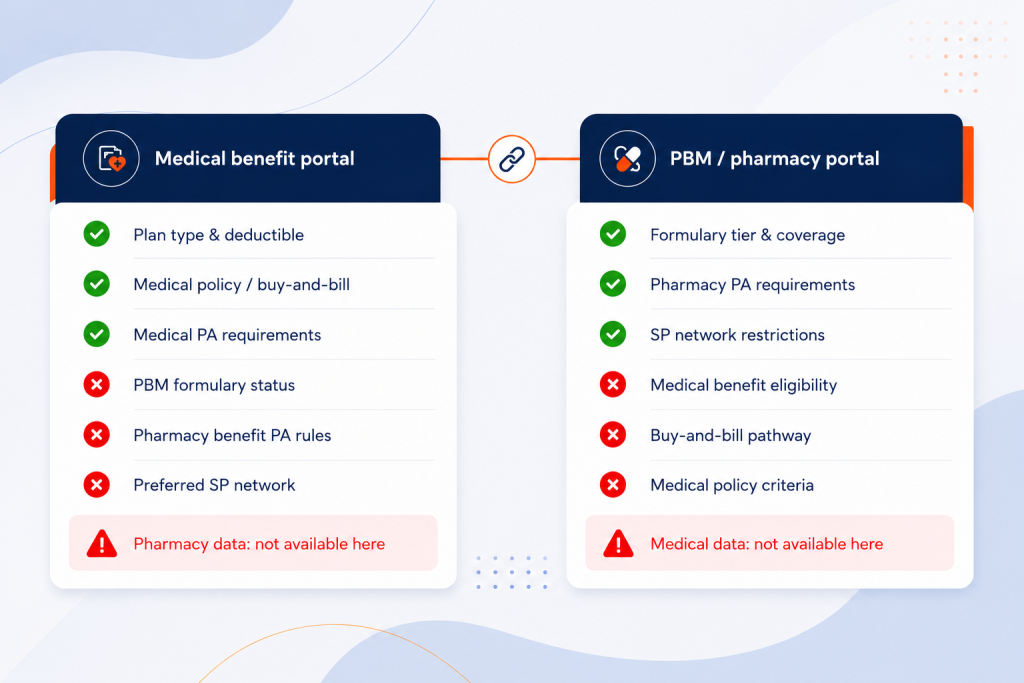
In U.S. healthcare, medical and pharmacy benefits are administered, documented, and verified through separate systems. Ask any benefits coordinator what their morning looks like and you will hear the same thing: payer portal for medical, PBM portal for pharmacy, a fax or two somewhere in the middle, and a spreadsheet holding it all together.
One Patient Journey with two Benefit Verifications.
The same therapy may fall under medical benefit, pharmacy benefit, or both.
And when teams struggle to do both quickly, patients wait while the workflow searches for direction.
Where the Split Starts Creating Friction
The delay often starts before PA, before denial, and before the patient even knows there is a problem.
Medical benefits sit in one payer portal.
Pharmacy coverage sits behind a PBM check.
Missing details move through calls, faxes, CRM notes, and spreadsheets.
Each source gives a piece of the case, but no one piece gives the full access direction.
Teams are trying to assemble the access path while the patient waits.
When medical and pharmacy benefits stay disconnected, friction becomes the workflow.
The Data Tells the Same Story
Specialty therapies are becoming a larger part of the access workload. IQVIA reported that specialty medications made up 53% of U.S. branded net sales in 2024, reaching $262 billion.
That means access teams are handling high-cost therapies, specialty tiers, PA rules, payer variation, pharmacy restrictions, and benefit-path decisions that directly affect speed to therapy.
For many therapies, the question is not just: Is this covered?
The real question is:
Which benefit path gives this patient the fastest access?
When medical and pharmacy benefits are checked separately, teams may get an answer from one side.
But they may still miss the full access picture.
A case may look blocked under one benefit while another route is still available. A PA may be prepared for the wrong pathway. A case manager may spend hours checking portals, calling payers, following up with providers, and waiting for specialty pharmacy updates.
This is why separate benefit checks are no longer enough.
The Better Model: One Workflow for Benefit Intelligence
A Single-Workflow model gives access teams the full benefit picture earlier, so they can choose the right route before the case moves too far in the wrong direction.
This is where Value Health fits.
Value Health brings medical and pharmacy benefit visibility into one connected view, helping teams identify the right benefit path, prepare more accurate PA submissions, catch coverage gaps earlier, and move cases with fewer handoffs.
Instead of managing medical and pharmacy benefits as separate checks, teams can see coverage status, PA needs, payer rules, restrictions, cost signals, and next actions from one place.
That is the shift from benefit verification to benefit intelligence.
How One Single Workflow Accelerates Patient Access at Every Step
1. Finds the Right Benefit Path Faster
Teams can quickly identify whether the case should move through buy-and-bill, specialty pharmacy, PBM coverage, medical policy, or an alternate access pathway.
This reduces early guesswork and helps the case start with clearer direction.
2. Makes PA Preparation More Accurate
Medical and pharmacy benefits can carry different PA rules, forms, and documentation needs.
Value Health helps teams identify the correct PA pathway, required documents, and payer-specific criteria earlier.
3. Reduces Manual Chasing for Case Managers
Case managers often move between payer portals, PBM checks, calls, faxes, spreadsheets, and CRM notes.
Value Health brings benefit status, PA needs, restrictions, cost signals, and Next Best Actions into one view.
4. Aligns FRMs and HUB Teams on One Case View
FRMs, HUB teams, and case managers often support the same patient journey from different sides.
A shared view gives teams visibility into blockers, documentation needs, access status, and next actions.
5. Reduces Wrong-Route Denials and Rework
Wrong benefit routing can lead to denials, duplicate submissions, and delayed approvals.
Value Health helps teams compare medical and pharmacy benefit logic earlier to support cleaner submissions.
6. Moves Patients Forward with Fewer Handoffs
Access slows when every step needs another portal check, call, or team update.
Value Health connects the benefit picture into one workflow, helping teams move from “Where do we check next?” to “What action moves this patient forward now?”
What Value Health Brings Into the Access Workflow
Value Health’s one-workflow eBV model does more than bring medical and pharmacy benefits together.
It gives access teams the intelligence needed to decide, route, prepare, and act faster.
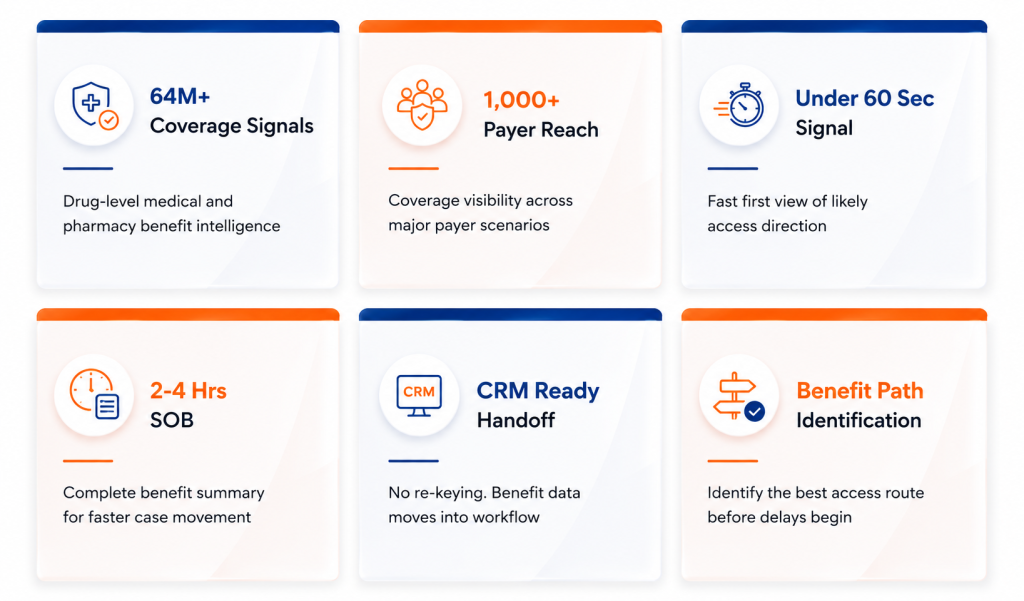
64M+ formulary and coverage data points help teams understand drug-level coverage, benefit fit, formulary position, and access risk earlier in the case.
1,000+ payer footprint gives teams broader visibility across real-world payer scenarios, reducing dependency on scattered manual checks.
Sub-minute initial coverage signals help teams quickly understand the likely access direction, so the case does not sit idle while teams wait for the full benefit picture.
2-4 hour complete Summary of Benefits gives case managers a clearer view of coverage status, PA requirements, restrictions, patient responsibility, and route-specific next steps.
API-first handoff into CRM and HUB workflows ensures benefit intelligence flows directly into case operations, where teams can trigger tasks, coordinate follow-ups, align FRMs, and act on Next Best Actions.
The Right Workflow Turns Information into Action.
Benefit clarity is powerful, but it cannot sit outside the workflow.
Once the right benefit path is identified, the case still needs to move through enrollment, documentation, PA preparation, provider follow-up, HUB coordination, FRM visibility, affordability checks, and specialty pharmacy handoffs.
That is where Value Health goes beyond Electronic Benefit Verification.
Value Health helps teams turn medical and pharmacy benefit intelligence into real case action through custom CRM workflows designed for patient access operations.
The eBV layer helps teams understand the right access path.
The CRM layer helps teams manage what happens next.
That means benefit outcomes do not stay as static information. They can move into case tasks, PA workflows, document tracking, provider follow-ups, FRM visibility, HUB coordination, and Next Best Actions.
This helps access teams move from:

The workflow is not built like a generic CRM screen.
It is built around how access teams actually work across medical benefit, pharmacy benefit, buy-and-bill, specialty pharmacy, PBM coverage, payer rules, provider documentation, and patient support.
So Value Health does not just help teams check medical and pharmacy benefits.
It helps them operationalize the answer.
The result is a more connected access workflow where the path is visible, the next step is clear, and the patient does not wait while teams decide what to do next.
Patient Access Should Never Break Between Benefits
Medical and pharmacy benefits may be managed through separate systems, but the patient journey cannot afford to move that way.
For specialty therapies, the right access path is not always obvious. When teams are forced to check these paths separately, every case carries the risk of delay, rework, missed coverage, and unclear next steps.
Access teams need more than separate benefit answers.
They need one clear view that supports the right PA, aligns the right teams, and turns coverage information into confident action.
Value Health brings that clarity into one workflow, backed by eBV strength, custom CRM workflows, and deep patient access expertise.
The result is a cleaner, faster, and more controlled access journey.
Because patients should not wait while teams search across disconnected systems.
When the benefit path is clear, the workflow becomes stronger.
When the workflow is connected, teams move faster.
And when teams move faster, patients get closer to therapy.
Bring medical and pharmacy benefits into one connected access Workflow with Value Health’s ebV
Let Every Benefit Check End in Progress
“Care delays are just the beginning of the problem” – Dr. Bruce Scott, American Medical Association
Medical and pharmacy benefits may begin on separate paths but they should come together around one patient, one clear next action and one shared goal: moving closer to therapy.
Because patient access is not about finding an answer. It is about turning the right answer into faster access to therapy.