


How Value Health and Patient Nexus Help Life Sciences Organizations Accelerate Patient Access Across Every Step of the Journey
In patient access, every day matters. A delay at enrollment, a bottleneck in benefit verification, a manual step in prior authorization, or a gap in case visibility can prevent a patient from starting the therapy they need precisely when they need it most.
Healthcare organizations continue to invest in technology, yet many patient access and support workflows remain fragmented, manual, and heavily dependent on administrative effort. The result is a longer time-to-therapy, increased operational costs, and a patient experience that falls short of what Life Sciences companies and their PSP partners are committed to delivering.
Intelligent workflow automation is changing that reality. By combining AI, purpose-built healthcare automation, and connected workflow orchestration, forward-thinking PSP organizations are eliminating bottlenecks, accelerating patient progression, and redefining what operational excellence looks like across the patient access journey.
This white paper examines the most common workflow bottlenecks that extend time-to-therapy, the operational impact of intelligent automation, and how Value Health and its flagship platform, Patient Nexus, serve as a trusted partner for Life Sciences organizations ready to transform patient access operations.
Understanding Time-to-Therapy
Time-to-therapy refers to the period between a patient’s initial enrollment or prescription and the moment they begin treatment. In Patient Services Programs, that window encompasses multiple sequential and interdependent operational steps, each one representing an opportunity to accelerate patient access or a potential source of delay:
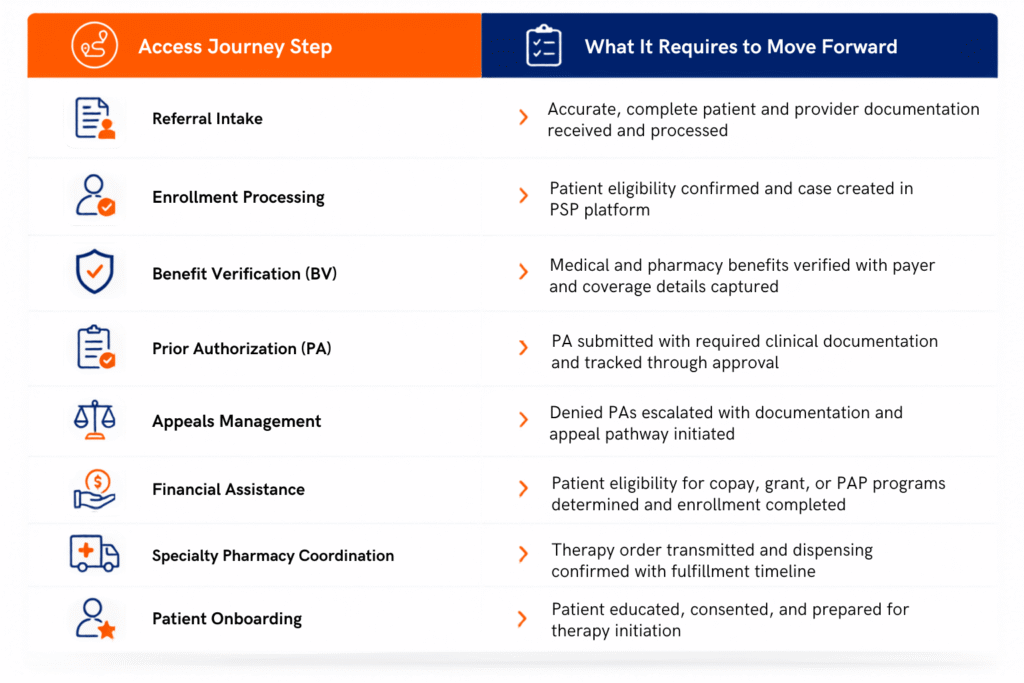
Each step is operationally significant on its own. In sequence, they form a chain where a delay at any point compounds into a longer overall timeline. For patients with chronic or serious conditions, these compounding delays are not just operational inconveniences. They are clinical risks.
Common Workflow Bottlenecks That Delay Therapy
Most PSPs, hubs, and specialty pharmacies face a consistent set of operational challenges that slow patient progression through the access journey. Understanding where delays originate is the first step toward eliminating them.
Manual Intake Processing
Enrollment forms, insurance documents, consent forms, and clinical records arrive through multiple channels simultaneously. Without automated classification and extraction, intake teams spend significant time manually reviewing, indexing, and routing documents before a case can even be created. Every hour spent on manual intake adds to time-to-therapy.
Benefit Verification Delays
Incomplete patient information, disconnected payer systems, and fragmented medical and pharmacy benefit workflows slow eligibility and coverage determination. When benefit data cannot drive an immediate next action, cases sit in a state of partial resolution while agents determine what to do next.
Prior Authorization Complexity
Manual PA submissions, payer-specific clinical documentation requirements, and limited visibility into authorization status create repeated follow-up cycles and longer approval timelines. Missing a single required document can restart the clock on an approval that was already in progress.
High Administrative Workloads
Case managers and support teams spend a disproportionate share of their capacity. Mostly on repetitive administrative tasks, data entry, document retrieval, status follow-ups, and after-call documentation. Rather time could be spenton the high-value patient and provider interactions that require their expertise.
Limited Workflow Visibility
Without real-time visibility into case status across the full patient population, teams struggle to identify where cases are stalled. What information is missing, which patients are at risk, and what the right next action is for each situation. Operational blind spots create backlog and erode program performance.
The bottleneck is rarely a single step. It is the friction between every step.
The Role of Intelligent Workflow Automation
Intelligent workflow automation combines AI, purpose-built healthcare workflow logic, and human “in the loop” oversight to reduce operational friction across the patient access journey. It is not about replacing the teams who support patients. It is about empowering them to focus on the work that requires expertise, empathy, and decision-making. While automation handles the high-volume, repetitive, and time-sensitive tasks that currently consume their capacity.
The key capabilities that define intelligent workflow automation in a PSP context include:
- Automated document classification and intake across all intake channels
- Intelligent data extraction with contextual understanding of patient, payer, provider, and therapy information
- Workflow routing and prioritization based on case status, risk signals, and program requirements
- AI-assisted benefit verification that connects coverage data to workflow decisions
- Electronic prior authorization workflows with status tracking and missing document identification
- Automated patient communications that keep patients informed and reduce inbound call volumes
- Real-time operational dashboards that surface what is missing, pending, blocked, or ready to progress
- Next best action recommendations that guide teams toward the highest-impact intervention for each case
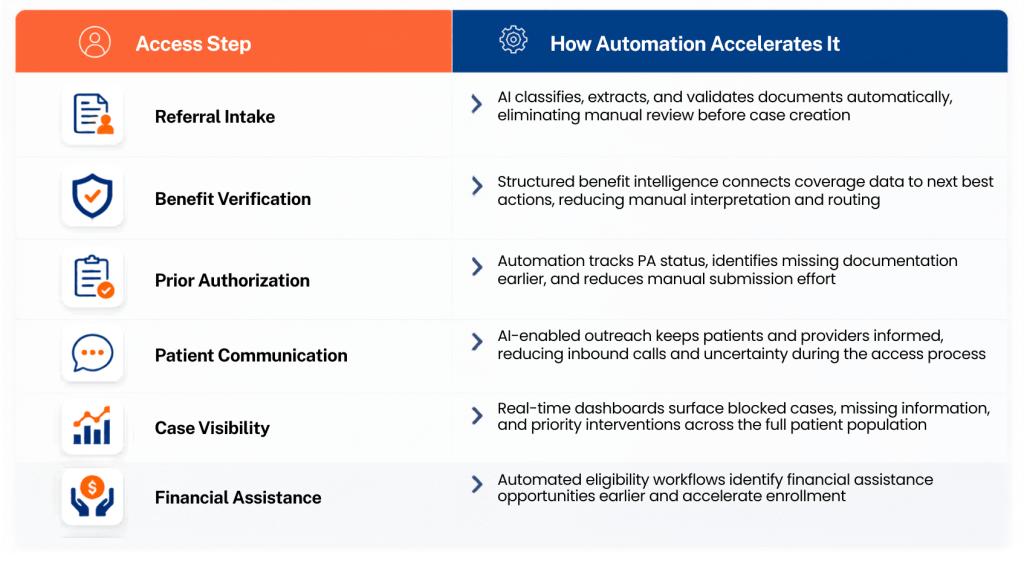
How Automation Accelerates Patient Access at Every Step
The impact of intelligent workflow automation is not limited to a single step in the patient access journey. When automation is applied systematically across the workflow, the cumulative effect on time-to-therapy is substantial.
The Business Impact: Why Automation Is No Longer Optional
The operational case for intelligent workflow automation in patient access is both clear and urgent. These are the realities facing PSP programs, hubs, and specialty pharmacies that continue to rely on manual, fragmented workflows:
Up to 35% of healthcare staff time is spent on administrative tasks that intelligent automation can handle, freeing teams for higher-value patient interactions.
Multiple channels most PSP intake teams still manage documents across email, fax, portals, and PDFs without a unified, automated processing workflow.
Compounding delays a bottleneck at any single access step does not stay contained. Delays in intake cascade into benefit verification, which cascades into PA, which delays therapy initiation.
Direct clinical impact time-to-therapy is not only an operational metric. For patients with serious or chronic conditions, delays in access have measurable clinical consequences.
Scalability without headcount organizations that implement intelligent automation report handling higher patient volumes without proportional increases in staff, improving program economics while maintaining quality.
Organizations that embrace intelligent workflow automation consistently report measurable improvements across five dimensions: reduced time-to-therapy, improved operational efficiency, higher team productivity, better patient experiences, and stronger compliance and data quality across program operations.
Why Human Oversight Still Matters: AI-Led, Human-Assured
Healthcare workflows involve clinical, financial, and patient-specific considerations that require human judgment, empathy, and expertise. Intelligent automation is not designed to remove human teams from the patient access journey. It is designed to ensure that human teams are focused on the moments where their judgment matters most.
At Value Health, we operate on an AI-Led, Human-Assured philosophy. AI handles the repetitive, high-volume, and time-sensitive tasks across patient access workflows while healthcare professionals oversee critical decisions, exception management, compliance requirements, and patient-facing interactions that require a human touch.
AI handles the volume. People handle what matters most.
This Human-in-the-Loop (HITL) model ensures that automation delivers speed without sacrificing accuracy, quality, or the trust that patients and providers place in the programs that support them. Every automation decision is designed with human oversight as a core requirement, not an afterthought.
Value Health AI Has a Solution: Patient Nexus and the Full Automation Platform
Value Health AI is a trusted partner for Life Sciences organizations, PSPs, hubs, and specialty pharmacies that are ready to modernize patient access operations. Our platform combines healthcare expertise, AI-powered automation, and purpose-built workflow accelerators to reduce time-to-therapy. It improves operational efficiency, and deliver better outcomes for the patients at the center of every program. Learn more at www.valuehealthai.com.
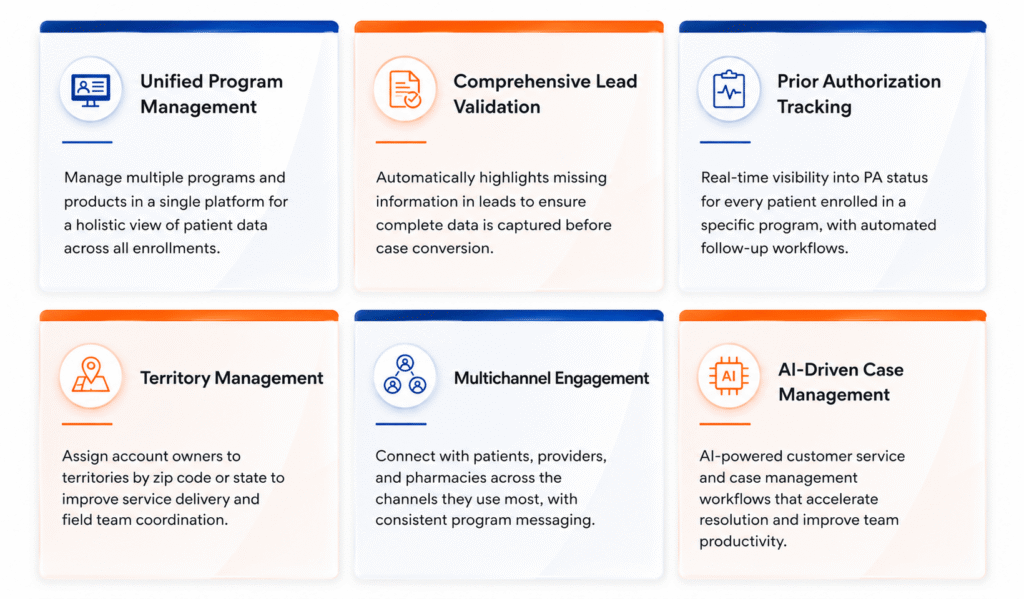
At the core of our patient access offering is Patient Nexus, our flagship PSP platform purpose-built for pharmaceutical companies, patients, and healthcare providers.
Patient Nexus
A comprehensive, patient-centered PSP platform built on Salesforce Health Cloud, combining industry-leading workflows, AI-powered automation, and the trust and security required for HIPAA and PII data.
Patient Nexus is available now. Schedule a consultation and explore the platform at valuehealthai.com/patient-nexus.
A Trusted Partner Across Every Dimension of Patient Access
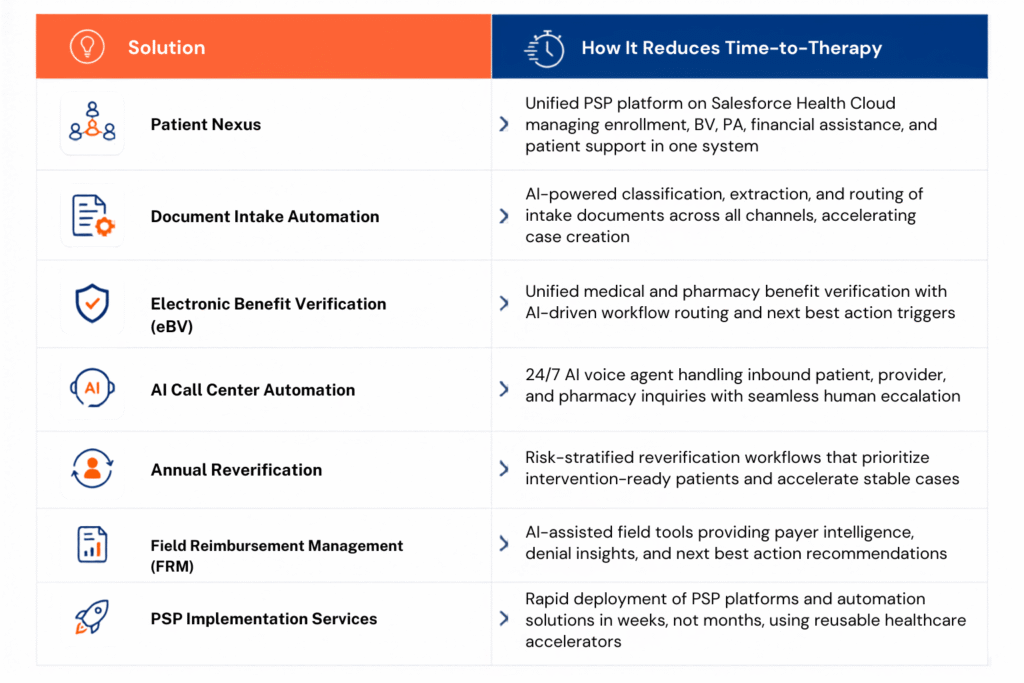
Patient Nexus is one part of a broader portfolio of AI-powered solutions that Value Health deploys across the patient access ecosystem. Our solutions are purpose-built for the operational complexity of Life Sciences and are designed to work as an integrated platform. Or as targeted solutions that address specific workflow challenges:
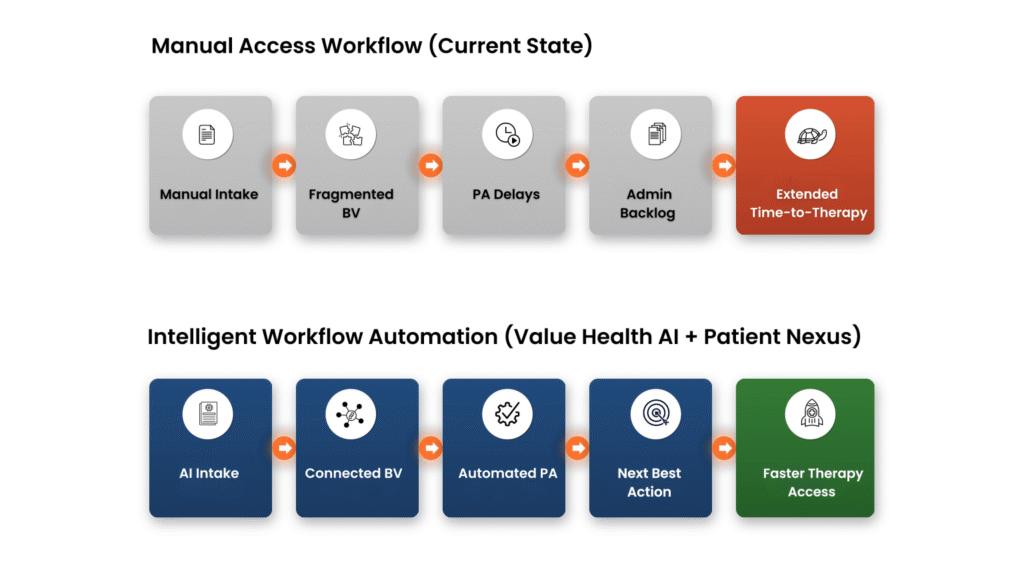
From Fragmented to Connected: The Workflow Intelligence Difference
The shift from manual, fragmented patient access workflows to intelligent, connected automation is the defining operational transition for PSP programs today.
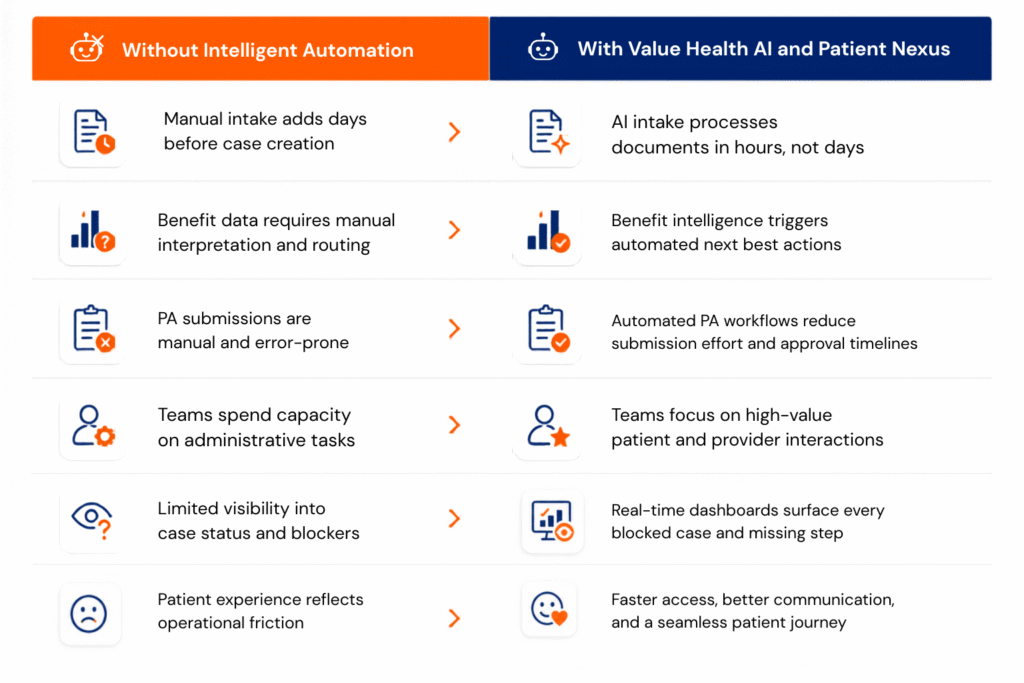
What Intelligent Automation Delivers for Patient Access Programs
Organizations that partner with Value Health AI to implement intelligent workflow automation across their PSP operations experience a measurable transformation across the full patient access journey:
Removing the Barriers Between Patients and the Therapies They Need
Reducing time-to-therapy is not simply about moving faster. It is about identifying and removing the operational barriers that stand between patients and the therapies that can change lives. Every fragmented workflow, every manual step, and every visibility gap is a barrier. And every one of them is addressable with the right technology, the right expertise, and the right partner.
Value Health AI brings together healthcare domain expertise, AI-powered automation, and a proven implementation approach to help Life Sciences organizations, PSPs, and hubs modernize patient access operations. Our solutions deploy in weeks, not months, using reusable healthcare accelerators built specifically for this environment.
Patient Nexus is at the center of that offer. A comprehensive, Salesforce Health Cloud-based PSP platform that connects enrollment, benefit verification, prior authorization, financial assistance, and patient support. All in a single, unified system designed to accelerate therapy access and improve outcomes for every patient in every program.
Ready to Reduce Time-to-Therapy Across Your Patient Access Program?
Partner with Value Health AI to deploy intelligent workflow automation that accelerates patient access, empowers your teams, and delivers measurable outcomes across your PSP. Schedule a consultation and start your transformation today.
Explore Patient Nexus: valuehealthai.com/patient-nexus