


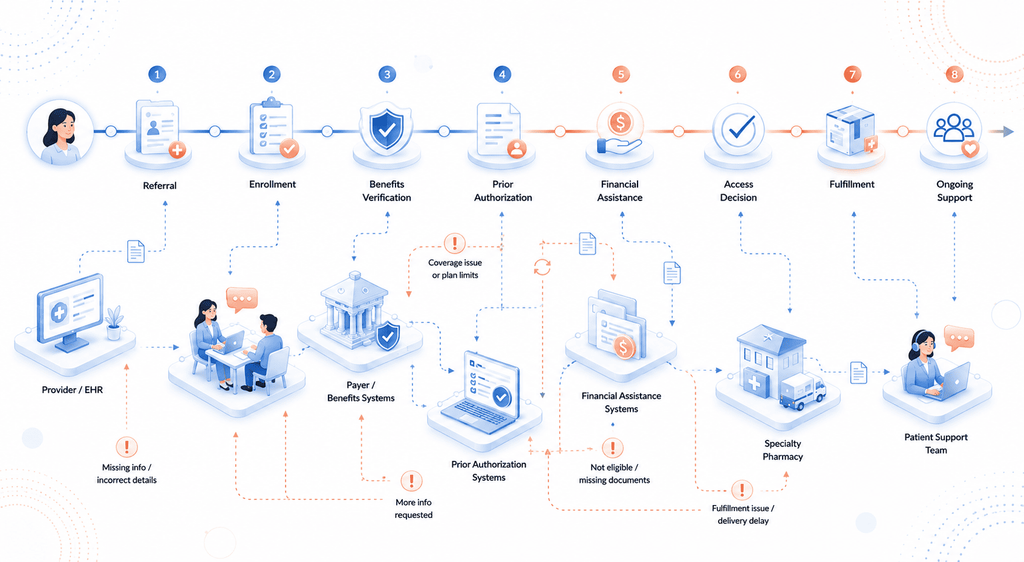
A pharmaceutical Patient Support Program rarely becomes difficult because of one complicated task. The difficulty builds as a patient moves from one required action to the next.
A referral arrives. Enrollment information is collected. Benefits are verified. A prior authorization may be required. Additional information is requested. Financial assistance may need to be assessed. Once access is established, the case may move to fulfillment and then into ongoing support.
Each stage can have its own process, people, rules, and technology.
The patient, however, experiences none of those boundaries. To the patient, it is one journey.
That creates an important question for pharmaceutical organizations: if each system is doing what it was designed to do, why can the overall PSP journey still require so much coordination?
The answer often sits between the systems.
PSP is a journey. The platform should connect it
In practice, it is rarely linear.
A benefits verification result can create a prior-authorization requirement. A prior-authorization request can require additional documentation. A denial can trigger another course of action. A change in insurance can require reverification. A fulfillment issue can send a case back to another team.
The challenge is therefore not only processing each stage. It is maintaining the context, information, ownership, and next best action as the case moves between them.
That distinction matters because the technology supporting one stage does not automatically eliminate the coordination required around it.
Where the coordination work appears
Consider benefits verification.
A patient-services representative needs information about the patient, prescriber, drug, pharmacy, payer, and plan to initiate a verification request. Salesforce’s current documentation, for example, supports pharmacy benefits verification within Life Sciences Cloud and describes electronic and manual verification requests involving payers or clearinghouses. Salesforce also documents connections to external services containing benefits information.
The important point is not that a CRM cannot support benefits verification. Modern life-sciences CRM platforms clearly can.
The operational question is what happens around that transaction.
Someone still needs to interpret the result, determine whether the case can proceed, identify whether another requirement has emerged, document the outcome, and move the case to the appropriate next step.
Prior authorization introduces another set of dependencies. The case may require clinical documentation, payer-specific requirements, submission, responses to requests for additional information, and a final determination. Financial assistance introduces its own eligibility and documentation requirements.
The technology can capture these activities. The organization still has to connect the activities into a patient journey.
That is where coordination work accumulates.
The same problem looks different across the organization
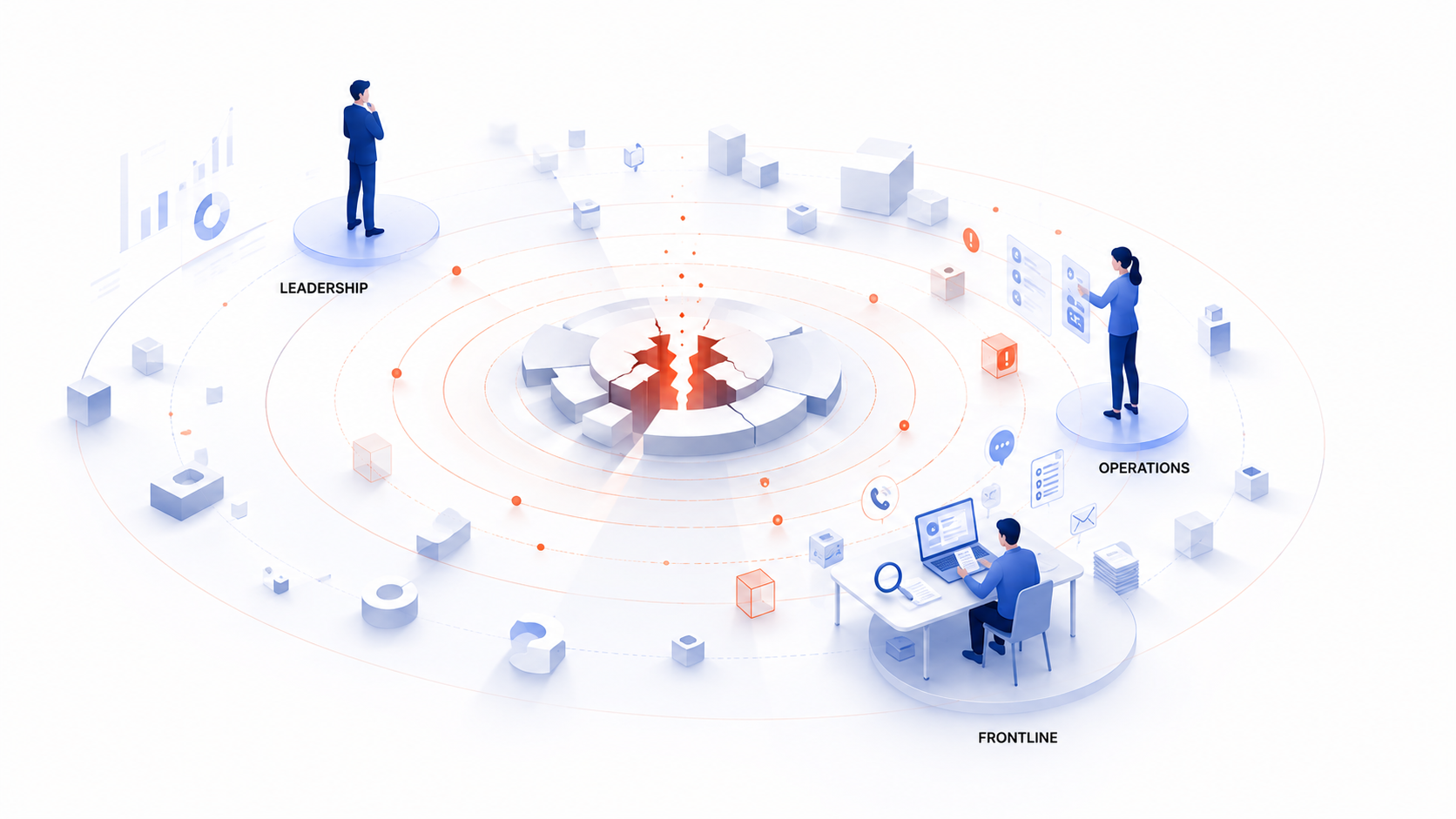
For a PSP leader, fragmented coordination may appear as inconsistent visibility into case progression, difficult program reporting, or uncertainty about where patients are getting delayed.
For an operations manager, it appears as queues, aging cases, reassignment, missing documentation, follow-up work, and exceptions that require intervention.
For a frontline employee, it is much more practical: finding information, checking status, entering information, documenting an interaction, contacting another party, and determining what needs to happen next.
The underlying problem is the same.
The patient journey crosses organizational and technological boundaries, while responsibility for moving the case forward remains with people.
CMS highlights interoperability as a way to support more coordinated care.
This is why describing the issue simply as “manual work” is incomplete. The deeper issue is the administrative effort required to maintain continuity between workflows.
What an End-to-End PSP Platform Changes
An end-to-end PSP platform is not defined simply by the number of functions it contains. Its value comes from how those functions work together around the operational realities of pharmaceutical patient support.
For PSP teams, this means capabilities such as:
- Journey-aware case progression – carries the context of previous actions, decisions, and requirements forward instead of treating every activity as an isolated task.
- Rules-driven workflows – applies program-specific eligibility, routing, documentation, escalation, and decision rules to determine how cases progress.
- Exception management – identifies cases that fall outside the expected path and routes them for appropriate intervention.
- Intelligent information handling – extracts, organizes, and summarizes information from documents and case materials within the workflow.
- Next best action intelligence – helps teams identify what requires attention without repeatedly reviewing the complete case history.
- Program-level configurability – allows forms, workflows, rules, reports, and processes to adapt as program requirements change.
- Connected external interactions – keeps information exchanged with payers, providers, pharmacies, and other external services connected to the underlying case.
- Operational visibility – gives program leaders and operations teams a clearer view of case progression, workload, exceptions, and program performance.
These capabilities form the foundation of Medivo 360, an end-to-end PSP platform designed around pharmaceutical patient-support operations. Its product scope includes case and task management, benefits verification, prior authorization, financial assistance, site-of-care coordination, fulfillment management, patient support, analytics, and AI-assisted workflow capabilities.
The distinction is not simply having more functionality.
It is having technology that understands the relationships between activities, decisions, requirements, people, and outcomes within a PSP.
That is what makes an end-to-end platform useful: it maintains continuity as cases progress while giving each team the information and actions relevant to its role.
Why more CRM configuration is not always the complete answer
Pharmaceutical PSPs are not static programs.
Enrollment criteria change. Assistance rules change. Payer requirements change. Products, indications, specialty-pharmacy arrangements, forms, documentation requirements, and reporting needs can change as well.
A configurable CRM is valuable in this environment. But adapting to a CRM-centered environment can also involve configuring workflows, integrating external services, maintaining data structures, and managing changes across the surrounding technology landscape.
That does not make CRM technology unsuitable.
It means pharmaceutical organizations need to evaluate the architecture at the level of the complete PSP workflow, rather than at the level of individual features.
The better question becomes:
How much of the patient-support journey can the organization manage as one connected PSP process, rather than coordinating the journey across applications, integrations, and human handoffs?
The case for an end-to-end PSP platform
This is where an end-to-end PSP platform takes a different approach.
The starting point is the patient-support journey itself.
Referral and intake connect to enrollment. Enrollment connects to consent and onboarding. Benefits verification connects to access requirements. Prior authorization and financial assistance connect to the access decision. Fulfillment connects to ongoing patient support. Program activity connects to analytics and operational visibility.
The objective is not necessarily to replace every external system involved in healthcare.
The objective is to provide a technology environment specifically designed around the sequence of activities required to move a PSP case forward.
Medivo 360 follows this end-to-end PSP platform approach.
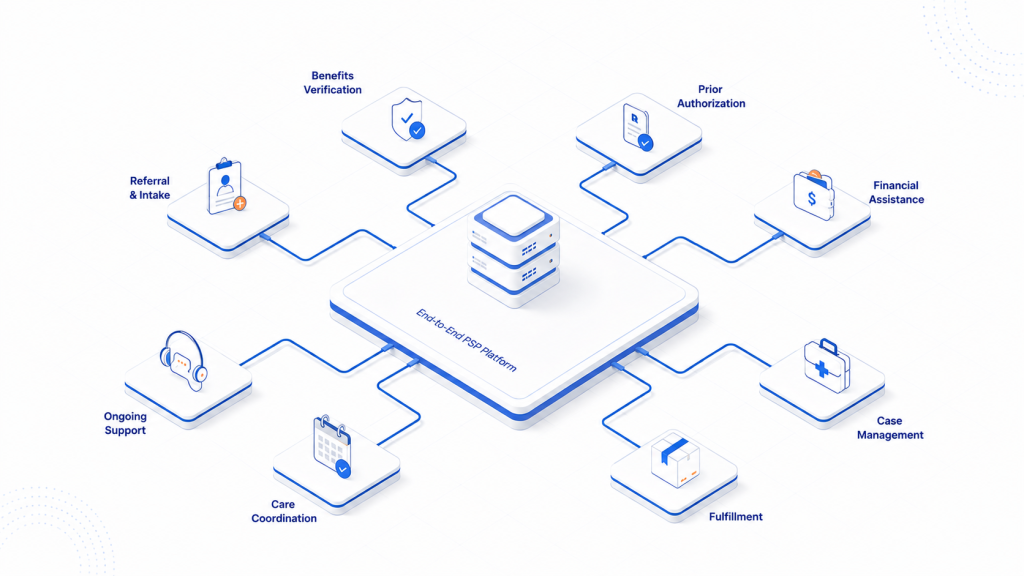
Its scope spans referral and intake, enrollment, consent and re-consent, benefits verification, prior authorization, financial assistance, case management, site-of-care coordination, fulfillment, ongoing patient support, and program analytics. It also incorporates AI-assisted capabilities intended to support activities such as information extraction, case summarization, identifying missing information, and surfacing next actions.
That changes the technology conversation.
Instead of asking only:
“Where is the patient record?”
the organization can also ask:
“What stage is this patient in, what is preventing progression, who owns the next best action, and what information is required to move the case forward?”
That is the practical distinction between adding capabilities to a technology environment and using an end-to-end PSP platform designed around the patient-support journey.
AI has a role, but it is not the story
AI becomes useful when it addresses actual work within that journey.
It can help extract information from documents, summarize case history, identify missing information, surface relevant case details, or assist with determining the next action.
The value is not simply that AI exists.
The value comes when intelligence is applied inside the workflow, where employees already have to review information, make decisions, document activity, and move cases forward.
AI, in this context, is a supporting capability – not the central argument.
What changes for the PSP teams?
The goal is not to suggest that an end-to-end PSP platform eliminates every manual activity.
Healthcare will continue to involve people, external organizations, payer decisions, clinical documentation, and exceptions.
The opportunity is more practical:
less searching, less reconciliation, fewer disconnected handoffs, and better visibility into what needs to happen next.
For leadership, that can mean a clearer view of program progression.
For operations, it can mean better visibility into queues, cases, and exceptions.
For frontline teams, it can mean spending less time reconstructing a case and more time acting on it.
The Million-dollar question for PSP technology
The evolution of PSP technology should not be reduced to a choice between “CRM” and “no CRM.”
CRM technology has an important place in pharmaceutical organizations, and modern platforms can support substantial portions of patient-services operations.
The more important question is whether the technology supporting the PSP can connect the entire patient-support journey, including its workflows, dependencies, external interactions, documents, rules, and next actions.
For pharmaceutical organizations, that may be the more useful way to evaluate PSP technology.
Not:
How many PSP features does our CRM have?
But:
How much coordination is still required to move a patient from one stage of support to the next?
That is where the difference between a CRM-centered environment and an end-to-end PSP platform that performs Next Best Action becomes meaningful.
The future of PSP technology is not simply about adding more systems or more automation. It is about giving the people responsible for patient support a more connected way to move the journey forward.
If you have more questions about PSP operations like the one above – Learn More