


Healthcare doesn’t have a staffing problem. It has a workflow problem.
It was 6:45 p.m., and Mark was still at the office.
As the Director of Revenue Cycle for a 120-provider multispecialty practice, he had watched the clinical teams head home hours earlier. The waiting room was empty, exam room lights were off, and the last patient had long since left the building.
But the work wasn’t over.
In the back office, one employee was sorting through a stack of incoming faxes. Another was on hold with an insurance company trying to verify benefits for tomorrow’s schedule. Two billing specialists were working denied claims from the previous week, while someone else manually copied information from payer portals into the practice management system.
Mark looked around and had the same thought he’d had dozens of times before.
“We need to hire more people.”
The truth was, he didn’t. He needed fewer manual processes.
That realization is becoming increasingly common among revenue cycle leaders across the country. Administrative costs continue to rise while reimbursement becomes more challenging. Staff work longer hours, yet backlogs continue to grow. Hiring additional employees provides temporary relief, but it rarely addresses the underlying issue.
The problem isn’t that healthcare organizations lack talented people.
The problem is that too many talented people spend their day doing work that technology is now capable of doing for them.
The Administrative Burden No One Talks About
Revenue Cycle Management has quietly become one of the most labor-intensive functions in healthcare.
Before a patient even receives treatment, someone has already verified insurance eligibility, confirmed benefits, checked payer requirements, gathered documentation, initiated prior authorizations, and updated multiple systems. Many of those steps still happen exactly as they did years ago. Staff move between payer portals, answer phone calls, manually enter data, and process faxes that continue arriving throughout the day.
None of these tasks are particularly difficult. The challenge is that there are thousands of them.
Research suggests that healthcare employees spend up to 35 percent of their time on administrative work, including benefit verification, documentation, and other repetitive processes that could be automated.
Those hours add up quickly. They increase labor costs, contribute to employee burnout, delay reimbursement, and create friction for patients who simply want to receive care.

Why More People Isn’t the Answer
When administrative work piles up, the instinct is usually to hire. Another eligibility specialist. Another billing coordinator. Another person to answer phones.
While those additions may reduce today’s backlog, they don’t change tomorrow’s workload. More employees simply process more paperwork. The underlying workflow remains exactly the same.
That’s why so many healthcare organizations feel like they’re running faster every year but never getting ahead.
The administrative burden isn’t growing because people are working less.
It’s growing because manual processes simply can’t keep pace with the increasing complexity of modern healthcare.
Where Generative AI Fits In
When most people hear “Generative AI,” they think about writing emails or creating presentations.
Healthcare providers should be thinking about something entirely different.
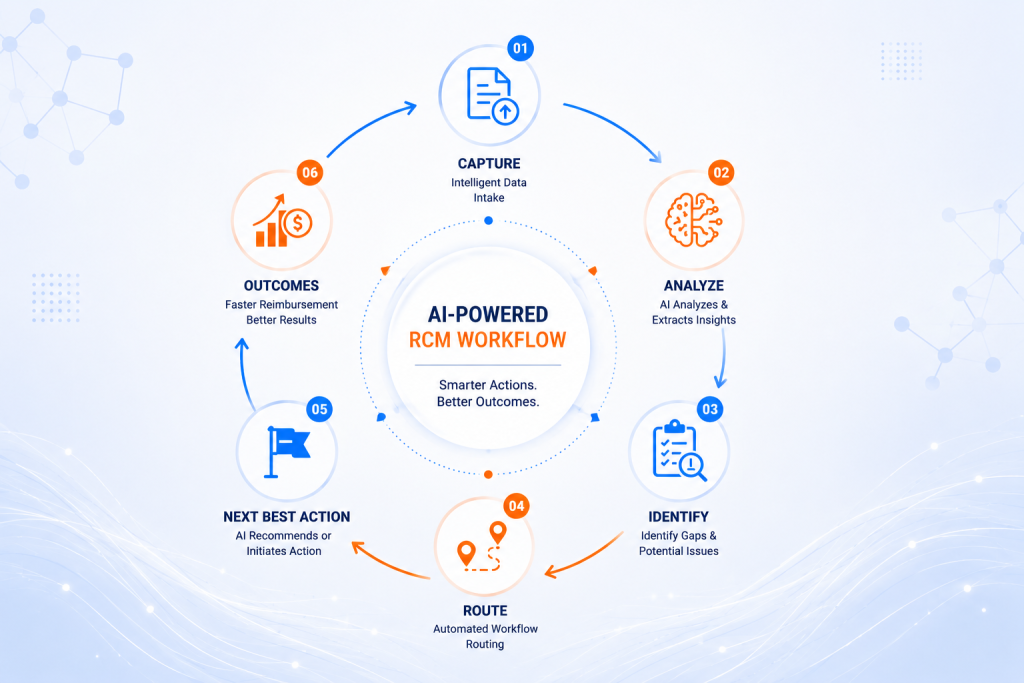
Imagine if AI could read every incoming fax the moment it arrived, extract the relevant information, verify insurance eligibility, identify missing documentation, recognize payer-specific requirements, and automatically route the case to the right person before an employee ever touched it.
Now imagine doing that hundreds of times every day.
That’s where the real opportunity lies.
Generative AI isn’t about replacing healthcare professionals. It’s about eliminating the repetitive administrative work that prevents them from focusing on higher-value activities.
Instead of employees spending hours collecting information, AI gathers it for them.
Instead of manually deciding what happens next, intelligent workflows recommend or trigger the next action automatically.
That’s a fundamental shift in how Revenue Cycle Management operates.
From Task Automation to Workflow Intelligence
For years, healthcare technology has focused on making individual tasks faster.
Verify benefits faster.
Process claims faster.
Answer calls faster.
Those improvements certainly help, but they don’t solve the larger problem.
Completing one task more quickly doesn’t eliminate everything that happens afterward.
The organizations seeing the greatest operational improvements are taking a different approach. They’re no longer thinking about isolated tasks. They’re thinking about connected workflows.
Every piece of information becomes an opportunity for action.

Benefit verification doesn’t simply confirm coverage. It identifies potential risks, flags missing documentation, and initiates the next step automatically. Instead of waiting in someone’s inbox or on a spreadsheet, work continues moving forward.
As we often say at Value Health, verification isn’t the outcome. Helping patients move efficiently through their care journey is.
A Better Way with Value Health
At Value Health, we’ve built our AI-powered platform around a simple idea: healthcare organizations shouldn’t have to redesign their business to benefit from artificial intelligence.
Our technology works alongside existing workflows, reducing administrative burden while helping teams become faster, more accurate, and more efficient.
Whether it’s electronic Benefit Verification (eBV), intelligent fax processing, payer intelligence, automated workflow routing, annual reverification, or AI-powered call center support, Value Health connects information to action.
Instead of leaving staff to manually interpret coverage details and decide what should happen next, our platform analyzes benefit information, identifies potential issues, surfaces missing documentation, and recommends or initiates the next best action automatically. That transforms benefit verification from a standalone task into the beginning of an intelligent workflow.
The result is fewer manual touchpoints, fewer delays, and a revenue cycle that moves faster without requiring additional administrative staff.
The Future of Revenue Cycle Management
Healthcare has never suffered from a lack of dedicated people.
It has suffered from too many manual processes.
The organizations that thrive over the next decade won’t necessarily be the ones that hire the most employees or implement the most software. They’ll be the ones that rethink how work gets done.
Generative AI offers an opportunity to remove administrative friction that has existed for decades. It allows organizations to reduce repetitive work, improve staff satisfaction, accelerate reimbursement, and create a better experience for patients from the very beginning of their journey.
The question isn’t whether AI can reduce administrative burden.
It already can.
The question is whether healthcare organizations are ready to stop managing paperwork and start building workflows that move patients, providers, and the business forward together.
Ready to Reduce RCM Administrative Burden with Gen AI?
Connect with Value Health AI to see how Gen AI can streamline RCM in your healthcare practice.
Visit us at www.valuehealthai.com or contact us at info@valuehealthsol.com