


Commercial Success Begins During Phase 3 Clinical Trials; Not at Approval
For many emerging biopharmaceutical companies, reaching Phase 3 clinical trial is one of the most significant milestones in a drug’s journey. Years of research, clinical development, and regulatory planning have led to a therapy that is now one step away from commercialization.
But while regulatory teams remain focused on clinical outcomes and approval timelines, commercial leaders face a different question:
Will patients be able to access the therapy on Day One?
The answer depends on much more than FDA approval.
A successful commercial launch requires patient services, reimbursement workflows, technology platforms, specialty pharmacy partners, operational teams, healthcare providers, and support programs to work together from the very first prescription. If any one of these components is unprepared, patient access slows, providers become frustrated and launch momentum can be lost.
This is why leading pharmaceutical and biotechnology companies no longer treat Patient Support Programs (PSPs) as a post-approval initiative. Instead, they begin designing them 12–18 months before launch, ensuring every operational component is aligned before commercialization begins.
Why Phase 3 clinical trial Is the Right Time to Start PSP Planning
Commercialization is often viewed as the final stage of drug development. In reality, it is an entirely new business function with its own operational complexities.
By the time a therapy reaches Phase 3, organizations already know far more than they realize:
- The target patient population
- Expected treatment pathway
- Anticipated provider specialties
- Likely payer landscape
- Distribution model
- Clinical workflow
- Patient support requirements
These insights provide enough information to begin designing the commercial support ecosystem.
Waiting until approval compresses months of planning into just a few weeks, forcing teams to make technology, vendor, staffing, and operational decisions under unnecessary pressure.
Instead, Phase 3 should mark the transition from clinical readiness to commercial readiness.
The Hidden Complexity Behind Every Drug Launch
Many organizations assume commercialization primarily involves selecting a HUB provider or implementing a CRM platform.
In reality, these are only individual components of a much larger ecosystem.
A successful Patient Support Program must connect multiple operational functions, including:
- Referral intake
- Patient enrollment
- Benefits verification
- Prior authorization support
- Appeals management
- Copay and financial assistance
- Specialty pharmacy coordination
- Patient communications
- Adherence programs
- Annual reverification
- Field reimbursement management
- Provider engagement
- Case management
- Reporting and analytics
- Compliance and quality oversight
Each function depends on standardized workflows, clear ownership, integrated technology, trained personnel, and measurable performance indicators.
Without careful planning, these areas often evolve independently, creating fragmented patient experiences and operational inefficiencies after launch.
The Cost of Waiting is Too Long
One of the most common misconceptions among first-time launch organizations is that Patient Support Programs can be finalized after regulatory approval.
While technically possible, this approach introduces significant operational risk.
Common challenges include:
Delayed Patient Access
Incomplete intake workflows, undefined reimbursement processes, and immature operating models often delay therapy initiation.
For patients with serious or progressive conditions, every additional day matters.
Last-Minute Vendor Decisions
Selecting a HUB provider is rarely a simple procurement exercise.
Organizations must evaluate vendors across multiple dimensions:
- Patient services expertise
- Therapy-specific capabilities
- Technology integration
- Compliance readiness
- Reporting capabilities
- Geographic coverage
- Scalability
- Cost structure
- Implementation timelines
Rushed evaluations frequently result in compromises that are difficult to reverse after launch.
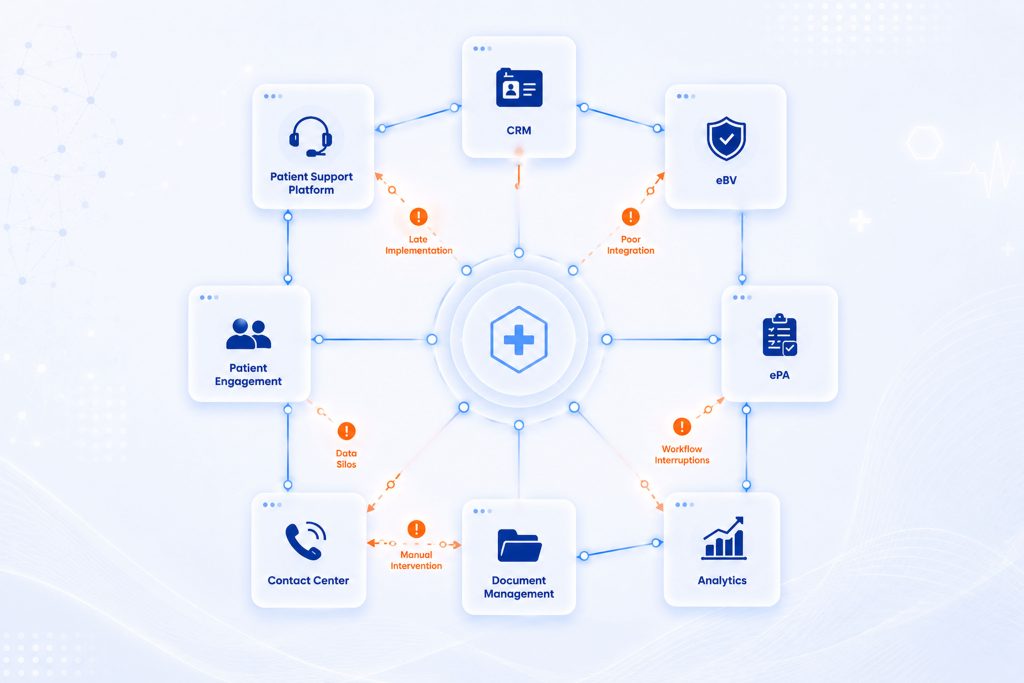
Technology Becomes the Bottleneck
Commercial teams typically rely on multiple technology platforms, including:
- CRM
- Patient services platforms
- Electronic Benefit Verification (eBV)
- Prior Authorization solutions
- Document management
- Analytics platforms
- Contact center technology
- Patient engagement tools
When implementation begins too late, technology projects often compete with launch deadlines, increasing deployment risk.
Operations Struggle After Launch
Even with the right vendors and technology, commercial success ultimately depends on execution.
Without clearly documented operating procedures, governance structures, escalation paths, and staffing models, teams spend the first several months reacting instead of optimizing.
Patients experience delays.
Providers receive inconsistent communication.
Operations leaders lose visibility.
What Should Be Planned During Phase 3?
Rather than viewing commercialization as a single project, organizations should approach it as a series of interconnected workstreams.
1. Design the Patient Journey
Every Patient Support Program begins with one question:
What experience should patients have from referral to ongoing therapy?
Mapping the patient journey helps identify every interaction, dependency, decision point, and potential barrier.
Typical stages include:
- Prescription written
- Referral received
- Benefits verification
- Prior authorization
- Financial assistance evaluation
- Therapy onboarding
- Dispensing
- Adherence support
- Reverification
- Ongoing patient engagement
A clearly defined journey becomes the foundation for every subsequent operational decision.
2. Define the Service Model
Once the journey is understood, organizations must determine:
- Which services will be offered?
- Which activities remain internal?
- Which functions should be outsourced?
- How will providers interact with the HUB?
- How will patients communicate with support teams?
- What service levels are expected?
These decisions influence staffing, technology, vendor selection, and budget planning.
3. Evaluate the Right HUB Partner
Choosing a HUB should never be based solely on cost.
Organizations should assess:
- Operational maturity
- Experience in similar therapeutic areas
- Clinical support capabilities
- Technology ecosystem
- AI readiness
- Reporting and analytics
- Integration flexibility
- Scalability
- Compliance
- Patient experience
The goal is to select a partner capable of supporting long-term commercial growth rather than simply processing referrals.
4. Build the Operating Model
An effective Patient Support Program requires clearly defined operational governance.
This includes:
- Roles and responsibilities
- SOPs
- Escalation pathways
- Service Level Agreements (SLAs)
- Quality monitoring
- Compliance oversight
- Cross-functional governance
- KPI ownership
A well-designed operating model ensures consistency across every patient interaction.
A Practical Timeline for Building a Launch-Ready PSP
One of the biggest mistakes commercial teams make is treating commercialization as a project that begins after regulatory approval. In reality, every month during Phase 3 presents an opportunity to reduce launch risk.
Rather than waiting for approval, leading organizations follow a phased commercialization roadmap.
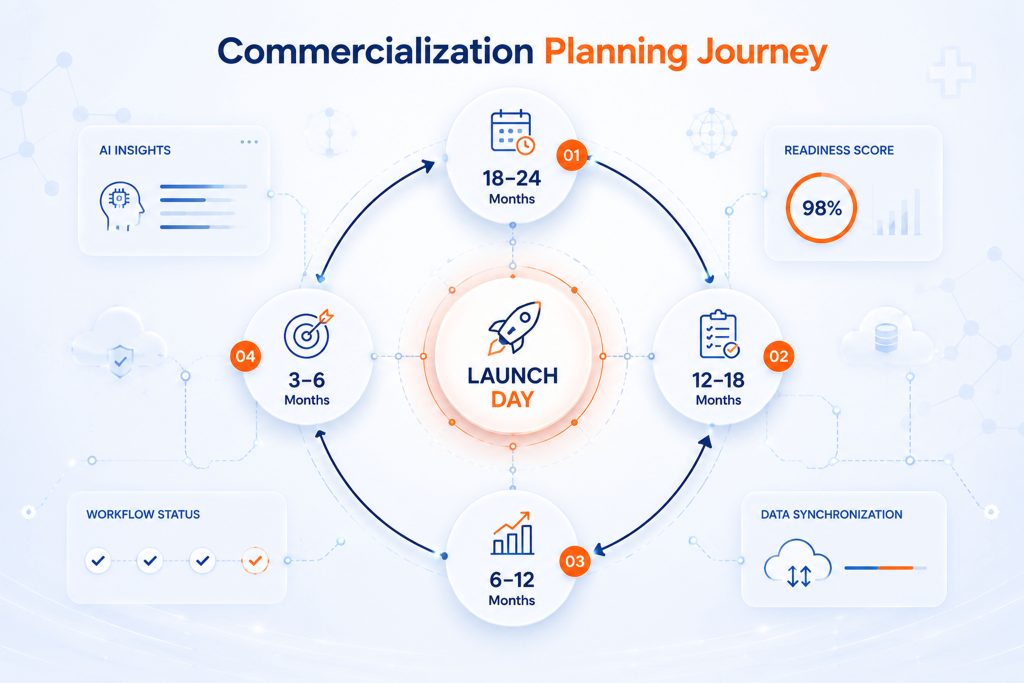
18–24 Months Before Launch: Define the Commercial Vision
This is where strategy takes shape.
The objective isn’t to finalize every operational detail, but to establish the commercial foundation.
Key activities include:
- Defining the Patient Support Program vision
- Mapping the end-to-end patient journey
- Understanding patient and provider personas
- Assessing payer dynamics and reimbursement pathways
- Estimating patient volumes
- Determining specialty pharmacy and distribution strategy
- Establishing commercial governance
At this stage, organizations should also begin identifying the operational capabilities they will need after approval—not just the technology they intend to purchase.
12–18 Months Before Launch: Design the Operating Model
Once the commercial strategy is clear, attention shifts toward execution.
This is where many organizations begin evaluating HUB providers, technology platforms, and operational partners.
Critical workstreams include:
- HUB vendor selection
- Patient Support Program operating model
- Service catalog design
- Case management workflows
- Benefits verification process
- Prior authorization workflow
- Financial assistance model
- Escalation pathways
- Standard Operating Procedures (SOPs)
- Governance and compliance framework
This is also the ideal time to document ownership across commercial, patient services, market access, medical affairs, and technology teams.
Without this alignment, even well-funded launches often struggle with fragmented execution.
6–12 Months Before Launch: Prepare the Technology Ecosystem
Technology should support the operating model—not define it.
Unfortunately, many organizations select platforms before they understand how their Patient Support Program will function.
Instead, commercial teams should first define their workflows and then evaluate technology that supports those workflows.
Common technology decisions include:
- Patient Support Platform
- CRM selection
- Electronic Benefit Verification (eBV)
- Electronic Prior Authorization (ePA)
- Document intake automation
- Provider portals
- Patient communication tools
- Contact center solutions
- Analytics and dashboards
- AI-enabled workflow automation
Organizations should also test how these systems exchange data, ensuring that patient information flows seamlessly across referral intake, reimbursement, specialty pharmacy, and patient support teams.
3–6 Months Before Launch: Validate Readiness
As launch approaches, the focus shifts from planning to preparedness.
Every component should be tested before the first prescription is received.
Key activities include:
- Staff training
- Pilot workflows
- Dry-run scenarios
- Vendor readiness reviews
- SLA validation
- Dashboard testing
- Escalation simulations
- Quality assurance
- Compliance reviews
- Go/No-Go readiness assessment
The goal is simple:
Launch with confidence and not assumptions.
Create a Checklist
Technology Alone Doesn’t Create Patient Access
Healthcare organizations often invest heavily in technology expecting it to solve operational challenges.
Technology certainly plays an important role.
However, software cannot compensate for unclear workflows, inconsistent governance, or poorly designed operating models.
Successful commercialization depends on connecting four critical pillars:
Strategy
A clear vision for patient support, access, and commercial execution.
Operations
Standardized workflows, governance, staffing, and quality processes.
People
Cross-functional teams aligned around common commercial objectives.
Organizations that balance all four are significantly better positioned for launch than those focused on technology alone.
The Growing Role of AI in Patient Support Programs
Artificial Intelligence is rapidly becoming part of commercial operations. But the greatest opportunity isn’t replacing people. It’s enabling them.
During commercialization, AI can help by:
- Classifying referral documents
- Extracting patient and insurance information
- Identifying missing documentation
- Supporting benefits verification
- Prioritizing prior authorization cases
- Suggesting next best actions
- Monitoring adherence risks
- Summarizing patient interactions
- Supporting contact center agents
- Highlighting operational bottlenecks
These capabilities reduce administrative burden while allowing patient support teams to focus on the interactions that require clinical judgment and empathy.
The result isn’t fewer people.
It’s smarter workflows.
Common Mistakes Phase 3 Organizations Make
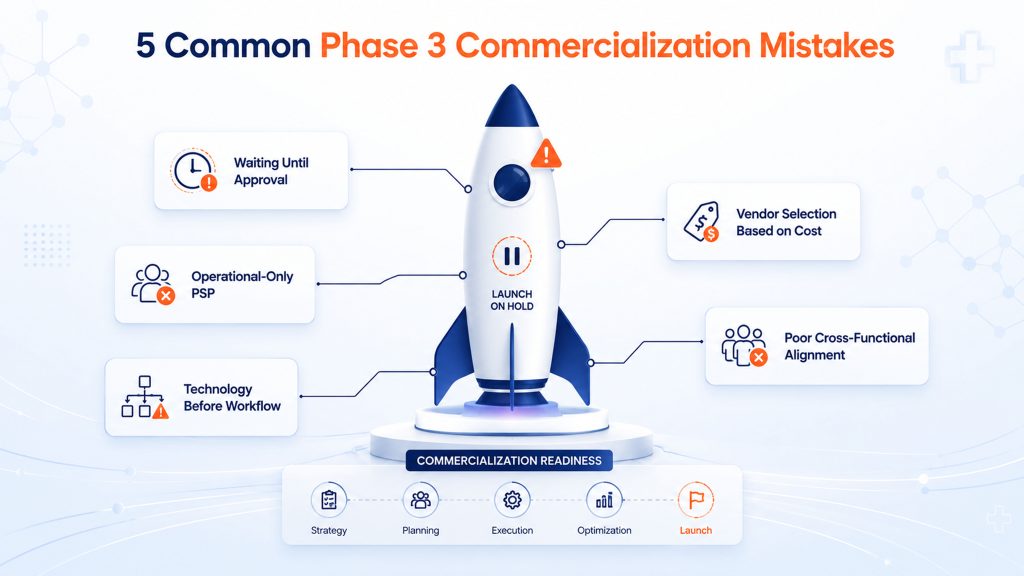
Across the industry, similar patterns emerge.
Waiting Until Approval
Commercial planning becomes compressed, increasing implementation risk.
Treating PSPs as Operational Programs
Patient Support Programs are strategic commercial assets—not simply contact centers.
Selecting Technology Before Defining Workflows
Technology should enable operations rather than dictate them.
Choosing Vendors Solely on Cost
The least expensive option rarely delivers the greatest commercial value.
Operational maturity, scalability, healthcare expertise, and patient experience often have a greater long-term impact.
Underestimating Cross-Functional Alignment
Commercialization requires collaboration across market access, patient services, medical affairs, IT, legal, compliance, finance, and external partners.
Without structured governance, decision-making becomes fragmented.
What Best-in-Class Launch Readiness Looks Like
Organizations with mature commercialization practices share several characteristics.
They have:
- A clearly documented patient journey
- Defined operating models and governance
- Established SOPs
- Experienced implementation partners
- Integrated technology platforms
- AI-enabled workflow automation where appropriate
- Meaningful operational dashboards
- Vendor accountability
- Cross-functional launch governance
- Patient-centric performance metrics
Most importantly, they enter launch focused on supporting patients—not fixing operational gaps.
The Real Measure of Launch Success
Commercial launches are often measured by prescription volume or revenue.
While these metrics matter, they are lagging indicators.
Leading organizations ask different questions:
- How quickly can patients begin therapy?
- How many referrals move through the system without delays?
- How long does benefits verification take?
- How efficiently are prior authorizations completed?
- Where are patients dropping out of the journey?
- How visible are operational bottlenecks?
- Are providers receiving consistent support?
These measures reflect the true effectiveness of a Patient Support Program.
Commercial Readiness Begins Before Commercialization
Phase 3 represents more than the final stage of clinical development.
It is the beginning of commercial execution.
Organizations that begin Patient Support Program planning early gain valuable time to align strategy, operations, technology, vendors, and governance before launch pressures intensify.
The result is more than a successful launch.
It is a commercial foundation capable of supporting patients, providers, and internal teams from the very first prescription.
Launch Readiness Checklist
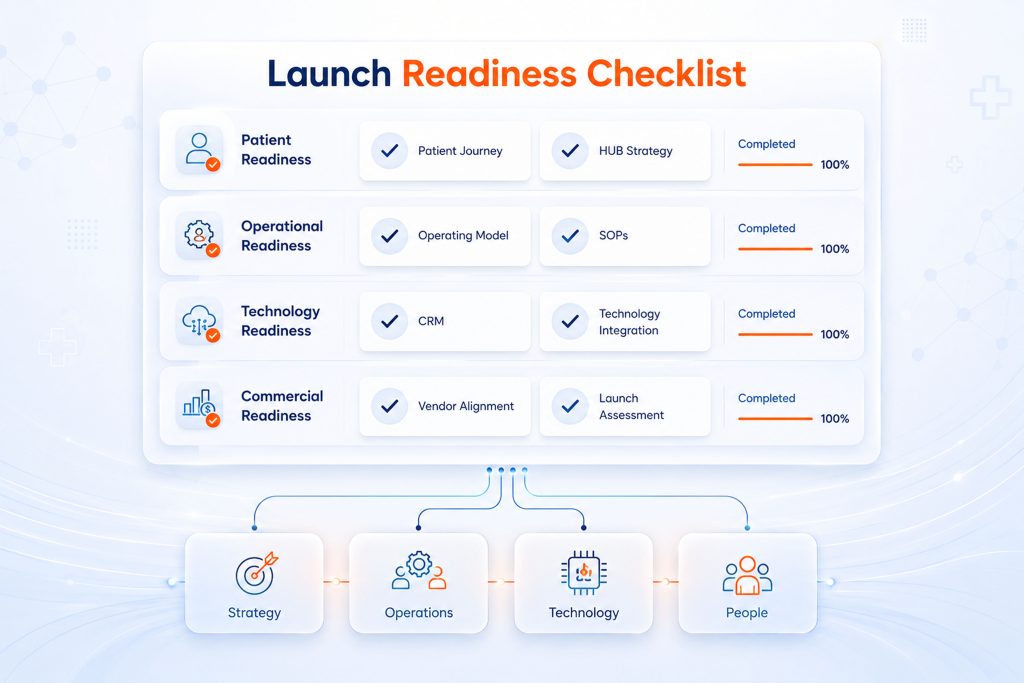
This is highly engaging and shareable.
Example:
Before your therapy reaches approval, ask yourself:
✓ Have we mapped the patient journey?
✓ Have we selected the right HUB strategy?
✓ Is our PSP operating model defined?
✓ Are SOPs documented?
✓ Is our CRM and technology roadmap finalized?
✓ Have we identified patient access bottlenecks?
✓ Are vendors aligned?
✓ Have we completed a launch readiness assessment?
Questions Every Phase 3 Team Should Ask
Examples:
- Are we planning for regulatory approval or commercial success?
- Can patients access therapy on Day One?
- Have we chosen the right operational model?
- Is our PSP scalable?
- Are our technology decisions driven by workflows?
Ready for Commercial Launch?
A successful launch starts long before approval. Connect with Value Health’s experts to build a launch-ready Patient Support Program that accelerates patient access and drives Day 1 success.