



Why the future of pharmaceutical patient support depends on balancing operational efficiency with accuracy, governance and human oversight.
“Speed moves a patient journey forward. Accuracy and accountability make sure it moves in the right direction.”
A patient is enrolled in a support program. Their documents have been received, their benefits are being verified, and their treatment journey is underway.
Behind this seemingly straightforward process, however, multiple activities are taking place. Information moves between teams, eligibility requirements are checked, patient records are updated, follow-ups are coordinated, and exceptions require attention.
As patient volumes grow and pharmaceutical support programs become more complex, managing these activities through disconnected systems and repetitive manual processes becomes increasingly difficult.
Automation offers a way forward. But there is a more important question pharmaceutical organizations need to consider:
Are we building patient support programs that simply work faster, or programs that work better?
The growing pressure on patient support operations

Patient Support Programs (PSPs) have become an important part of the pharmaceutical ecosystem. Beyond helping patients navigate treatment access, they support enrollment, benefits verification, financial assistance coordination, ongoing engagement and treatment continuity.
However, delivering these services consistently is not always straightforward.
Each patient journey can involve multiple stakeholders, different information channels, documentation requirements, and changing program conditions.
For pharmaceutical companies and their service partners, this creates several operational challenges:
- Fragmented information: Patient details and program updates may move across different systems, making it difficult to maintain a consistent view of each case.
- Repetitive administrative work: Document processing, data entry, verification and routine follow-ups consume valuable operational capacity.
- Limited process visibility: Delays and unresolved cases can become difficult to identify when information is distributed across teams and workflows.
- Inconsistent execution: Manual handoffs and variations in processes can create opportunities for errors and missed follow-ups.
These are not simply administrative inconveniences. They can affect how efficiently a program operates and how smoothly patients progress through their treatment journey.
As programs expand, the challenge is no longer just managing more cases. It is maintaining operational consistency without increasing complexity at the same pace.
Automation is accelerating. But is oversight keeping up?
Yet, an important finding deserves attention: only 16.4% of AI-using organizations had fully documented processes for monitoring models after deployment.
Although these findings cover healthcare organizations broadly rather than PSP operations specifically, they highlight a significant consideration for the industry: adopting technology and governing its performance are two different challenges.
For pharmaceutical organizations, the same principle applies to patient support automation.
Introducing automation into a workflow is only the beginning. Organizations also need to understand whether information is being processed accurately, whether exceptions are being identified, whether patient data is appropriately protected, and whether teams can intervene when something requires human attention.
Without these considerations, faster processes do not necessarily translate into better program performance.
Where efficiency needs accountability
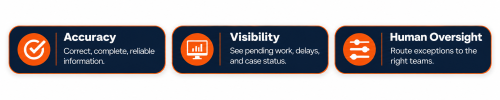
The objective of automation should not be to remove human involvement from every operational activity. It should be to ensure that human attention is directed where it creates the greatest value.
Consider three important areas.
- Accuracy must remain central to every workflow
Patient support operations depend on information being captured, interpreted, and maintained correctly.
An incomplete document, incorrect patient detail or missed eligibility requirement can create additional work and potentially delay the next step in a patient’s journey.
Automation can help standardize repetitive activities, reduce unnecessary manual handling, and improve consistency. However, processes should also include appropriate validation and exception-handling mechanisms.
The objective is not simply faster processing. It is a reliable process.
- Visibility should extend beyond task completion
A completed task does not necessarily mean a successful managed patient journey.
Operational leaders need to understand where cases stand, which activities are pending, where bottlenecks are emerging, and which cases require intervention.
A connected operational view makes it easier to identify delays, monitor workflows, and support informed decisions.
For pharmaceutical organizations managing multiple programs, this visibility becomes particularly important as operational scale increases.
- Human oversight should be built into the process
Not every patient case follows a predictable path.
Some require additional documentation, clarification, coordination or individual attention. These situations cannot always be managed through standardized workflows alone.
A well-designed automated process should distinguish routine activities from exceptions and ensure that cases requiring human intervention reach the appropriate teams.
This is where technology and human expertise should complement one another.
Automation should create more room for meaningful patient support, not make the process less responsive to individual needs.
The next competitive advantage: connected and governed operations
As the pharmaceutical industry continues to modernize patient services, the conversation needs to move beyond the number of tasks that can be automated.
The more meaningful questions are:
- Can organizations maintain consistent processes across growing patient volumes?
- Can program leaders identify operational issues before they become larger bottlenecks?
- Can patient information move across workflows without unnecessary duplication?
- Can teams identify when human intervention is required?
- Can organizations measure whether technology investments are improving actual program performance?
Answering these questions requires more than introducing individual automation tools.
It requires connected workflows, reliable information management, clearly defined responsibilities and the ability to monitor operational performance.
For pharmaceutical decision-makers, this also changes how technology investments should be evaluated. The value of a solution should not be measured only by the time saved on individual tasks, but by its contribution to program scalability, process consistency, operational visibility and patient experience.
Building the next generation of patient support
The future of PSP operations will not be determined by automation alone.
It will depend on how effectively organizations bring together technology, operational processes and human expertise.
At Value Health, this is an important consideration in how we approach patient support operations. Through connected PSP workflows and automation-led capabilities, the focus is on helping pharmaceutical organizations reduce operational friction, improve process visibility and support more coordinated patient journeys.
The opportunity is to move away from fragmented activities towards a more connected approach to patient support, where routine processes are streamlined and teams have greater visibility into the work that requires their attention.
Ultimately, the measure of progress should not be how much human involvement technology can eliminate.
It should be how much better organizations can use their resources to support patients.
Because the next evolution of patient support will not simply be about doing more with automation. It will be about building operations that are more accurate, accountable and responsive to the people they serve.