


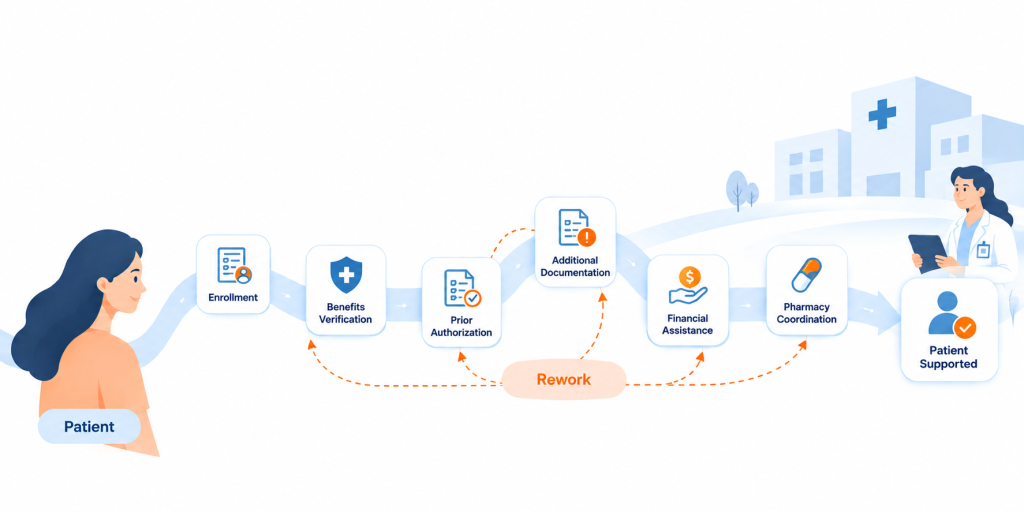
A patient may have one access journey. Patient Support Services within a pharmaceutical Patient Support Program (PSP) may have to manage that journey across several workflows, teams, systems, and decisions.
A case may begin with enrollment and benefit verification. Depending on the patient’s coverage and program requirements, it may then require prior authorization, additional documentation, financial assistance, specialty-pharmacy coordination, or another form of support.
The path is not always the same.
But one thing can happen at almost any point: the case needs another touch before it can move forward.
A touch may be a case review, a provider follow-up, a documentation request, a status check, a case update, a handoff, or an exception review.
The issue is not that every touch is unnecessary.
Some require human judgment.
The issue begins when people have to repeatedly reconnect information, status, and ownership just to get a case back to the point where the next step can happen.
The patient sees one journey. The organization may be managing many connected workflows behind it.
When the Work Does Not Stay Finished
A case can be worked without actually being ready to move forward.
Consider a case where the available information indicates that additional documentation is needed. Someone identifies what is missing and reaches out to the provider. In one Patient Assistance Program, 84% of initial applications were incomplete, and obtaining the missing information took an average of 8 days.
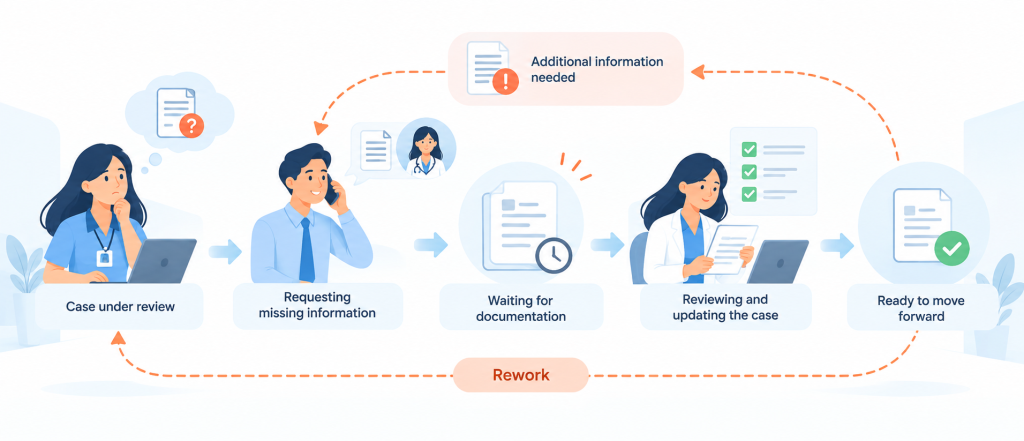
When the document arrives, someone has to review it, update the case, confirm what it supports, and determine what happens next.
The original task was completed.
But the case still requires another touch.
That is where rework begins.
The work is not necessarily caused by someone doing the original task incorrectly. It happens because the next stage cannot continue until another piece of information, documentation, status, or decision is available.
The same pattern can occur across different parts of Patient Support Services.
A benefits verification result may change the route a case needs to take. A prior authorization request may require additional information. A patient assistance review may require clarification or additional documentation. A specialty-pharmacy handoff may uncover something that needs to be resolved before the case can continue.
Each situation is different.
But the operational pattern is similar:
The case reaches a point where someone has to reconnect the pieces before the next action can happen.
Patient Support Services and the Operational Burden of Rework
One additional touch does not look significant on its own.
The problem appears when the same pattern repeats across a large pharmaceutical Patient Support Services operation.
A Case Manager may have to review a pending case, identify what is holding it up, determine who needs to respond, follow up, document the response, and review the case again when the information arrives.
Meanwhile, other cases are entering the queue.
This is where repeated coordination starts consuming operational capacity.
More time goes into maintaining existing cases. Less capacity remains available for cases that are ready for the next action.
The impact can appear in very practical ways:
- More cases remain pending.
- Follow-ups have become a larger part of daily work.
- Case queues require more monitoring.
- Teams spend more time determining what is still outstanding.
- Managers have more work to track across open cases.
- Scaling the program can require additional operational capacity.
The important point is not that every additional touch represents wasted work.
Some touches are necessary.
The question is whether the team is spending its time on work that requires human judgment or work that is simply reconnecting from a case that should already have enough context to move forward.
That distinction matters.
Because the operational burden is not only the number of tasks.
It is the number of times people have to pick up the case again.
What If the Workflow Could Keep Moving?
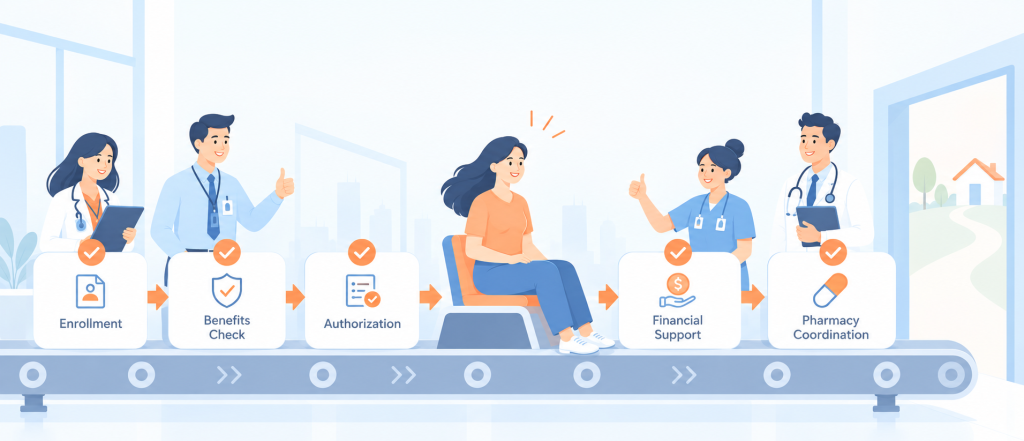
Think about a belt conveyor.
The conveyor does not eliminate the people working at each station. It simply removes the need for someone to physically carry the same item from one station to the next.
A connected Patient Support Services workflow can follow a similar principle.
The workflow not the patient keeps the relevant case information, current status, documents, and next action moving forward.
When a case reaches a new stage, the information already available can support the next action rather than requiring the team to reconstruct the case from the beginning.
If a benefits verification result indicates that another pathway is needed, the workflow can route the case accordingly.
If additional documentation is required, the workflow can identify the requirement and direct the request to the appropriate person or team.
When the required information becomes available, the workflow can continue from that point rather than forcing the case through completed steps again.
If an exception occurs, the case can be directed to the people who need to review it.
That is where technology becomes useful.
Not by removing people from the workflow, but by reducing the routine coordination people have to perform between workflow stages.
The Case Manager still matters.
They remain involved when a case requires judgment, communication, escalation, exception handling, or a decision that cannot be reduced to a routine action.
The difference is what happens around them.
Routine information and workflow actions can move forward. Human attention can stay focused on the cases that actually need it.
How Patient Support Services Can Keep the Patient Journey Connected
This is the principle behind a more connected approach to patient access services.
Instead of treating benefit verification, prior authorization, patient assistance, documentation, and case management as isolated activities, technology can help connect the information and actions between them.
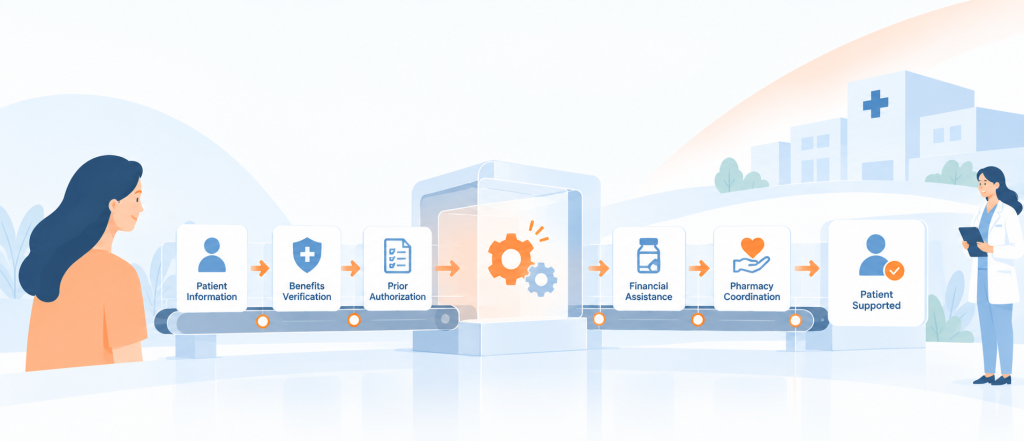
The result is not a promise of a completely touchless patient-support journey.
It is something more practical:
fewer unnecessary reconnective touches.
A case can carry forward the information already gathered.
A completed action can inform what needs to happen next.
A missing requirement can trigger the appropriate action.
A received document can return the case to the right point in the workflow.
An exception can reach the people responsible for resolving it.
And the Case Manager can spend less time figuring out how to reconnect the workflow and more time applying the judgment that the workflow cannot provide.
This is where connected e-Services can support pharmaceutical Patient Support Services.
The objective is not simply to automate individual tasks.
It is to keep the work between those tasks connected.
That changes the question from:
“How quickly can someone complete this task?”
to:
“How many times does this case need to be touched before it can move forward and which of those touches actually require a person?”
Bring us your PSP challenge. Let’s explore it together.