


Why benefit verification automation (eBV) can still leave teams with manual work and what it takes to move cases forward with confidence.

The benefit response arrives.
Status: Verified✅
It feels like the case should be ready to move.
Then the questions begin.
What does the benefit actually cover? Are there restrictions? Is prior authorization required? Does the case have enough information to move forward or does someone need to investigate further?
The system returned a response.
But the team is still searching for the next step.
This is where the hidden cost of benefit verification begins: not in retrieving the response, but in everything people must do to make that response usable.
A benefit response can arrive in seconds and still leave hours of work behind it.
1. The Benefit Came Back “Verified.” The Work Didn’t Stop.
Consider a situation many patient support teams know well.
A benefit verification is initiated for a patient. The electronic response comes back and confirms active benefits.
Good news but not the complete answer.
The case manager reviews the response and finds that some details remain unclear. A coverage condition needs confirmation. A restriction is mentioned without enough context. Prior authorization may be required, but the next step is not immediately visible.
Now the work begins.
The case manager opens another system, checks the payer portal, reviews plan information, contacts the payer, records the findings and determines which team should receive the case next.
The benefit verification was electronic.
The interpretation, coordination and next best action were not.
This is not an isolated workflow issue. According to the 2024 CAQH Index, 96% of medical eligibility and benefit verification transactions were already fully electronic in 2023. Yet CAQH still identified $12.3 billion in potential annual savings across medical and dental workflows through greater automation and improved business processes. CAQH CORE
That contrast raises an important question:
If benefit verification is already largely electronic, why is so much manual work still left?
Because electronic does not always mean clear, connected or ready for Next Best Action.
2. The Hidden Work Behind Every Unclear Response
The cost of an unclear benefit response rarely appears as one dramatic delay.
It accumulates quietly.
One more portal login.
One more payer call.
One more internal message.
One more case note.
One more handoff.
Each action may take only a few minutes. Across hundreds or thousands of cases, however, those minutes become hours of operational effort.
It may not include the time spent interpreting the result, finding missing information, following up with the payer, coordinating between teams or reopening the case when a restriction appears later.
A quick Benefit Verification workflow check
When a benefit response arrives, does your team still need to:
- Visit another system to understand the response?
- Contact the payer for missing details?
- Manually determine whether prior authorization is required?
- Send the case to another team without a connected workflow?
- Re-enter information that was already collected?
- Decide the next step from scattered notes and responses?
If several answers are “yes,” the verification may be automated but the surrounding work is not.
For case managers, this means more time searching and less time acting.
For program leaders, it means higher administrative costs, inconsistent case handling and a difficult question as volumes grow:
Can the program scale without adding manual effort at the same rate?
The real cost of benefit verification is not retrieving the response. It is making the response actionable.
3. Speed Matters. Decision-Ready Information Matters More.
Speed is essential.
An early verdict can give teams immediate visibility into the case. It confirms that the process has started, provides an initial direction and keeps the case from sitting untouched.
But speed creates real value only when it leads somewhere.
Compare these two outcomes:
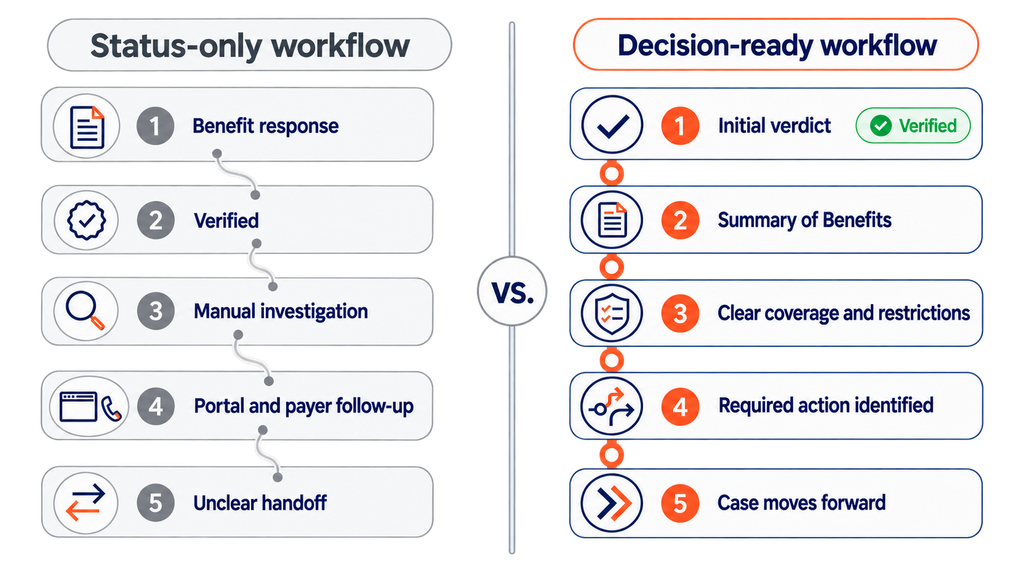
“The benefit has been verified.”
That is a status.
“The benefit has been verified, the details are available and the required next best action is clear.”
That is progress.
The difference is not simply more data. It is having the right information at the right stage of the workflow.
A useful benefit verification process should help teams answer three straightforward questions:
- What is the initial verdict?
- What does the Summary of Benefits tell us?
- What should happen next?
When those questions cannot be answered easily, the case slows down even when the original response arrived quickly.
The answer is not to choose between speed and detail.
Teams need an early signal to create momentum, followed by the information required to move forward with confidence.
The value of speed is not how quickly a response arrives. It is how quickly that response becomes action.
4. From Benefit Verification Response to Benefit Intelligence
A more effective benefit verification process should unfold naturally.
First, give the team an early indication of where the case stands.
Then, provide the fuller benefit details needed to understand it.
Finally, connect that information to the action that follows.
Value Health’s electronic Benefit Verification solution is designed around this progression.
An initial benefit verdict is available in seconds, giving teams early visibility without making them wait for the complete verification process.
A detailed Summary of Benefits follows within a 2- 4 hour SLA, giving the team the information needed to review the case and determine how it should proceed.
For some cases, that may be enough to continue.
For others, the Summary of Benefits may indicate that prior authorization is required. Instead of allowing the case to stop at that point, an integrated ePA workflow helps carry it forward into the next process.
The journey becomes simpler:
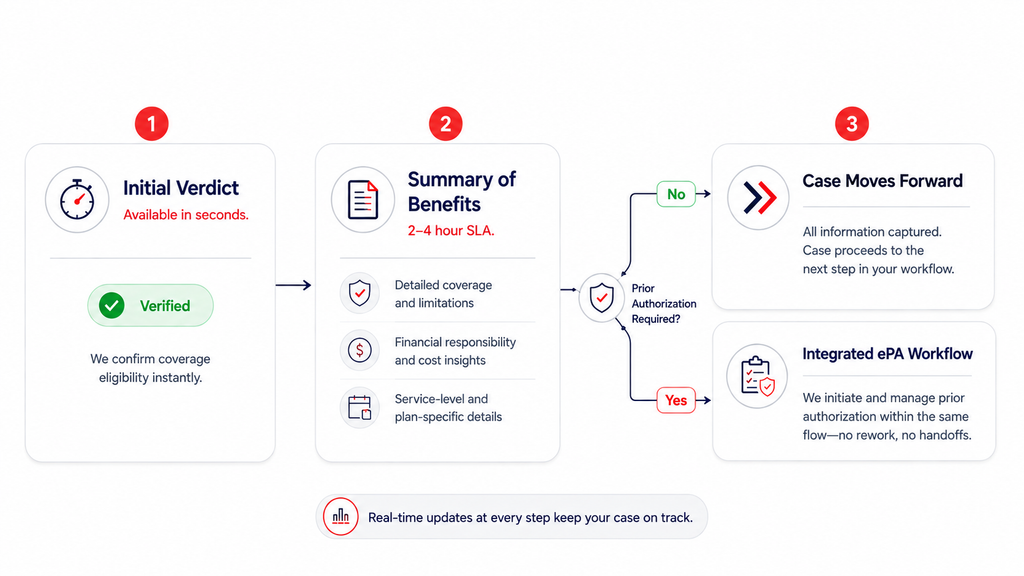
Get the verdict. Understand the benefit. Continue to the next best action.
Benefit verification stops being an isolated transaction and becomes part of a connected workflow. Teams are not simply told that another action is required; the case has a clearer path toward that action.
That matters because prior authorization remains one of healthcare’s least-automated administrative processes. The 2024 CAQH Index found that only 35% of medical prior authorizations were conducted fully electronically (CAQH CORE)
A connected transition from benefit verification to ePA can therefore reduce one of the most common points at which cases lose momentum: the space between identifying a requirement and beginning the work.
5. Automate the Predictable. Escalate the Uncertain.
Not every benefit response will be straightforward.
Some cases will contain incomplete information. Others may involve conflicting details, unusual conditions or exceptions that require human interpretation.
Those cases need experience and judgment.

But every case should not require the same level of manual investigation.
Routine cases can move through the verdict and Summary of Benefits with greater clarity. Cases that require attention can be surfaced for human review. When prior authorization is necessary, the integrated ePA flow can continue the process without forcing teams to restart elsewhere.
This changes the purpose of manual review.
People are no longer expected to investigate every response simply because the workflow cannot distinguish the clear from the uncertainty. Their time can be focused on cases where judgment genuinely matters.
Even CMS recognizes this balance in its guidance on electronic prior authorization for medical items and services: automation may improve decision timeframes, while some decisions will continue to require clinical review (CMS Prior Authorization API guidance)
The goal is not to remove people from benefit verification.
It is to give them fewer routine cases to investigate and better context for the complex cases that need them.
For case managers, that means less searching and fewer repetitive tasks.
For program leaders, it means more consistent case movement and a workflow that can scale more predictably.
For the patient journey, it means fewer avoidable pauses between one decision and the next.
Every Benefit Verdict Should Make the Next-Best Action Clear
A “verified” response should not begin another investigation.
It should give the team an early verdict, provide the benefit details needed for the case and create a clear path into the next best action.
Because the most valuable benefit verification is not simply the one that returns first.
It is the one that helps the case move forward.
See how Value Health transforms benefit verification into a clearer, more connected path forward.