


Reimagining Clinical Documentation around the Provider
It’s 8:15 PM.
The clinic closed hours ago.
The waiting room is empty. The nurses have gone home. The lights in most offices are off.
But a few screens are still glowing.
Inside, physicians are finishing patient notes they didn’t have time to complete between appointments – updating charts, reviewing medications, documenting diagnoses, and trying to remember conversations they had hours earlier.
Healthcare has a name for this.
“Pajama Time.”
It’s the work that follows physicians’ home, turning evenings meant for family, rest, or recovery into hours spent catching up on documentation.
And it’s happening more often than many realize.
Beyond the Keyboard hours:
For every 1 hour of patient care, physicians spend nearly 2 hours on EHR and desk work. Administrative burden has become one of the leading contributors to physician burnout, taking valuable time away from what matters most – patient care.
The impact goes far beyond long workdays.
Delayed documentation slows billing.
Incomplete notes increase compliance risks.
Revenue teams wait longer to process claims.
Healthcare IT teams continue searching for ways to simplify workflows without disrupting clinicians.
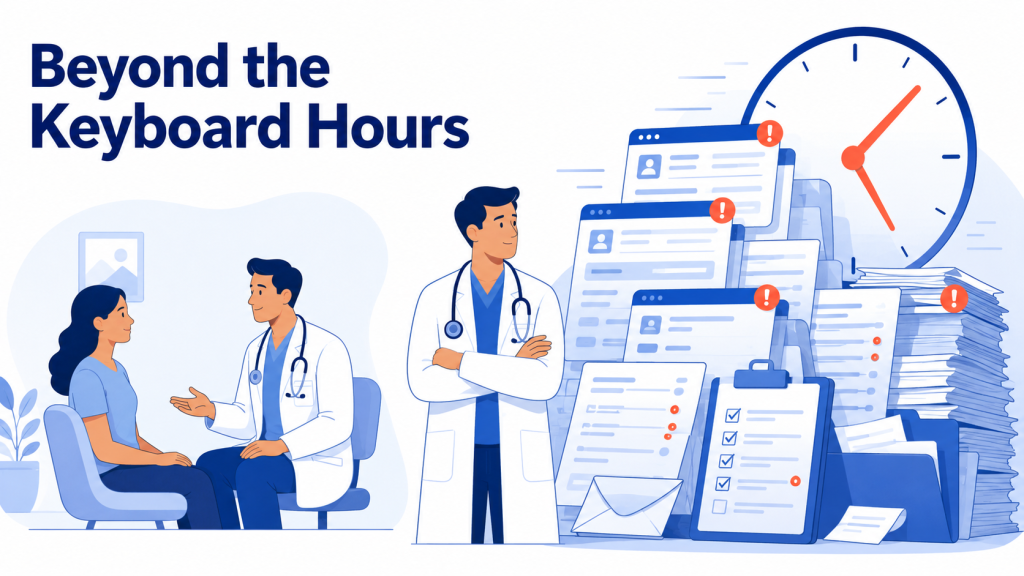
Most importantly, every minute spent documenting is a minute not spent with patients.
Healthcare has invested heavily in digital transformation – from Electronic Health Records (EHRs) and predictive analytics to connected care platforms. Yet one of the most essential clinical workflows remains surprisingly manual.
Clinical documentation.
So, what if documentation happened during the patient conversation instead of after it?
That’s exactly where AI Medical Scribes are changing the future of healthcare – not by replacing physicians, but by removing one of the biggest administrative burdens they face every day.
From Documentation to Clinical Intelligence
For years, digital documentation meant one thing: speech-to-text.
Doctors dictated notes.
Software converted speech into text.
Physicians still had to review, edit, organize, and manually update the EHR.
Today’s AI Medical Scribes are fundamentally different.
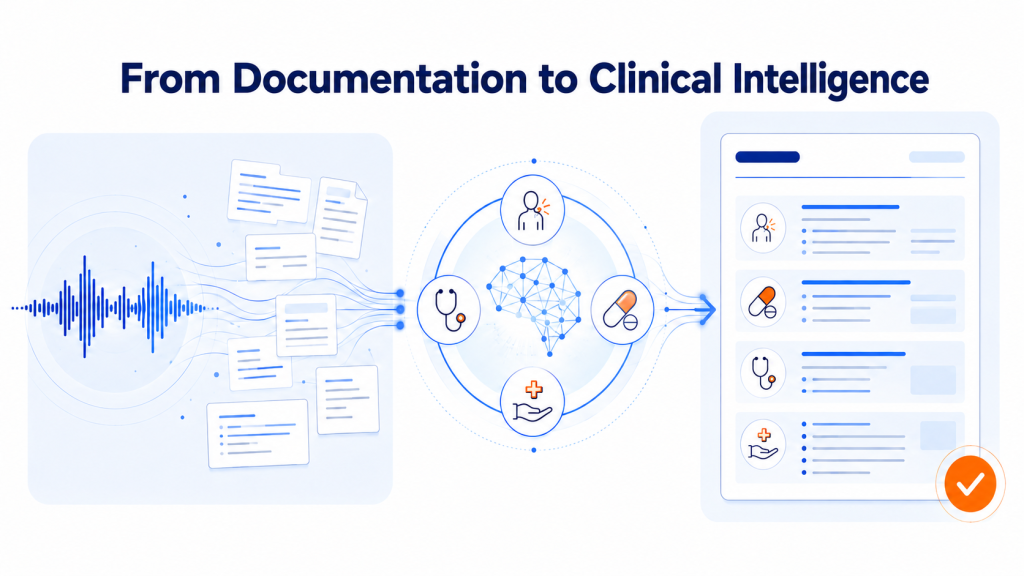
Instead of acting as transcription software, they function as intelligent clinical assistants.
With the appropriate patient consent, the AI securely listens to the natural conversation between the physician and the patient, understands the clinical context, identifies medically relevant information, and automatically creates structured documentation.
By the end of the consultation, physicians aren’t looking at a blank screen waiting to be filled.
They’re reviewing a well-organized draft that includes:
- SOAP Notes (Subjective, Objective, Assessment, Plan)
- Clinical summaries
- Treatment plans
- Encounter documentation
- Relevant clinical observations
The physician remains in complete control of the final documentation.
The AI simply removes the repetitive administrative work.
How AI Medical Scribe Fit into Everyday Clinical Workflows
One of the biggest strengths of an AI Medical Scribe is that it works quietly in the background, allowing clinicians to focus on conversations instead of keyboards.
The workflow is simple.
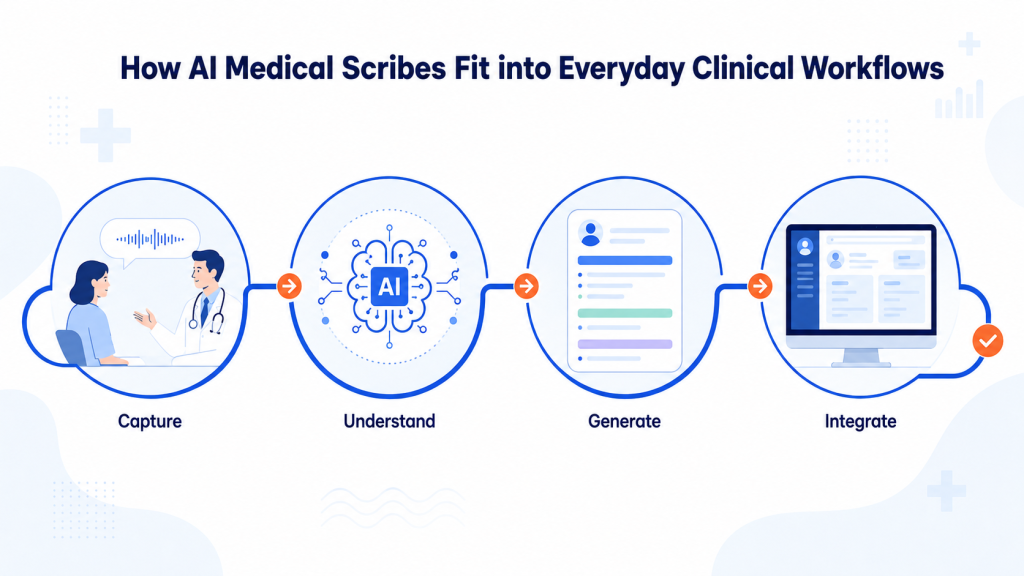
Capture
During the consultation, the AI securely captures the doctor-patient conversation in real time with appropriate consent.
Understand
Advanced Natural Language Processing (NLP) identifies symptoms, diagnoses, medications, treatment plans, and other clinically relevant details while filtering out non-essential conversation.
Generate
The AI automatically creates structured documentation, including SOAP notes and encounter summaries, reducing the need for manual typing.
Integrate
After physician review and approval, the documentation is seamlessly pushed into the organization’s EHR, eliminating duplicate data entry and accelerating clinical workflows.
Why Hospitals Are Investing in AI Medical Scribes
The benefits extend far beyond reducing physician documentation time.
Hospitals are adopting AI Medical Scribes because they improve performance across multiple departments.
| Stakeholder Group | Key Impact & Strategic Value |
| Physicians & Care Teams | Reclaims 1.5–2 hours daily. Cuts “pajama time” charting by 50–70%, lowers cognitive burden, and restores face-to-face patient eye contact. |
| Revenue Cycle Teams | Protects revenue integrity. Detailed, complete documentation supports precise CPT/ICD coding, reducing documentation-related claim denials. |
| Compliance & Quality | Standardizes note quality. Produces audit-ready, HIPAA-compliant clinical records with full clinician-in-the-loop sign-off. |
| Healthcare IT Leaders | Zero-friction deployment. Integrates into existing EHR architectures via standard FHIR/HL7 interfaces without requiring custom software training. |
More Than Time Savings – A Better Experience for Everyone
The value of an AI Medical Scribe isn’t measured only in minutes saved.
It’s measured in better conversations.
Better documentation.
Better clinician experiences.
Better operational efficiency.
And ultimately, better patient care.
When physicians spend less time documenting, they have more time to focus on listening, explaining, and building stronger relationships with patients.
At the same time, hospitals benefit from more complete documentation, improved coding accuracy, streamlined workflows, and stronger compliance.
The Future of Clinical Documentation Is Already Here
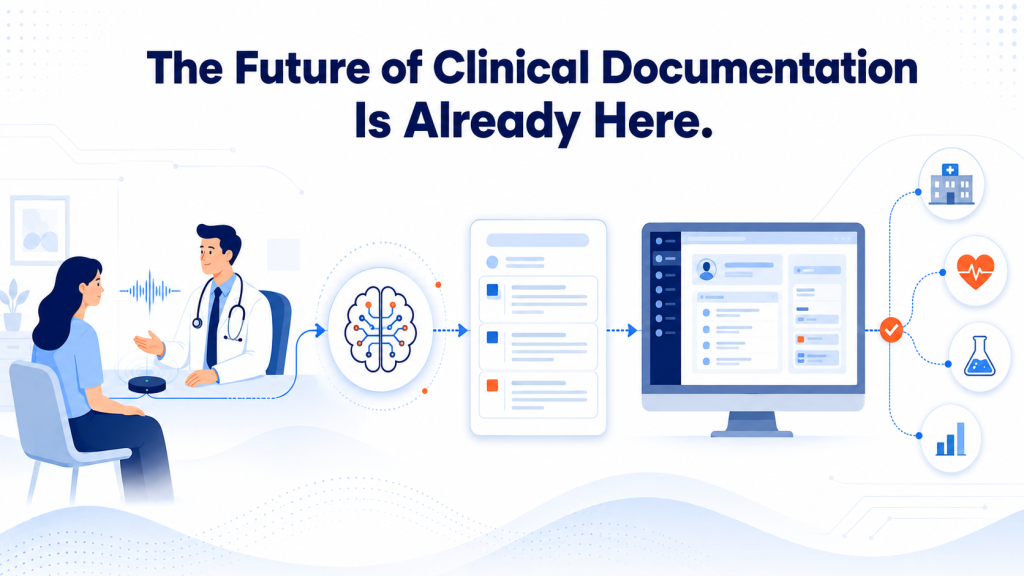
Healthcare isn’t slowing down.
Patient volumes continue to grow.
Administrative requirements continue to increase.
Clinician burnout remains a major concern.
Hospitals need solutions that improve efficiency without adding complexity.
AI Medical Scribe represent the next step in that journey.
The Effect
AI Medical Scribe transform clinical documentation from a manual, time-consuming task into an intelligent workflow that supports physicians, strengthens hospital operations, and improves the patient experience.
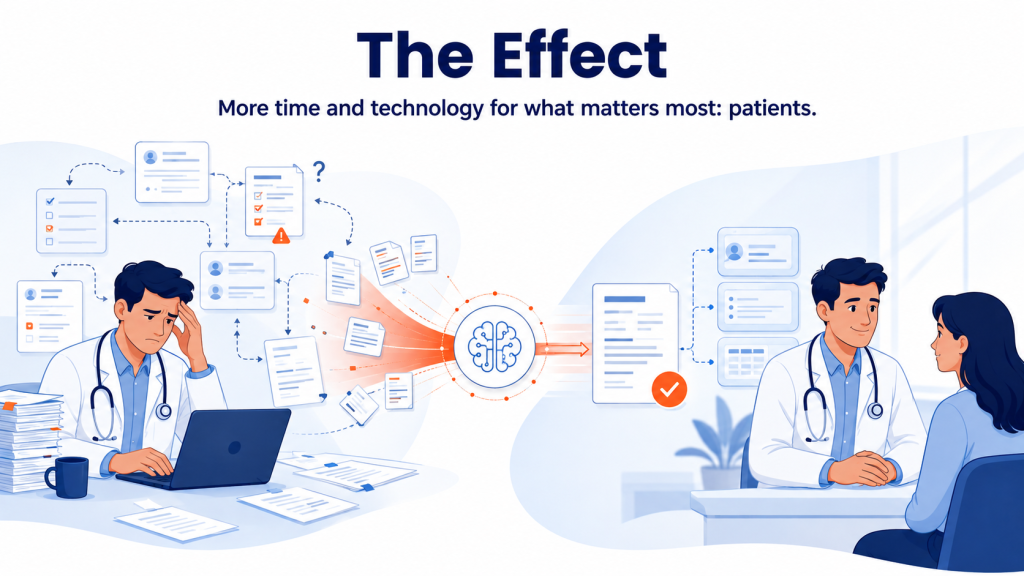
Because the future of healthcare isn’t about asking clinicians to do more.
It’s about giving them the time & the technology to focus on what matters most.
Their patients.
Want to see how AI Medical Scribes can improve clinical documentation without disrupting physician workflows?