


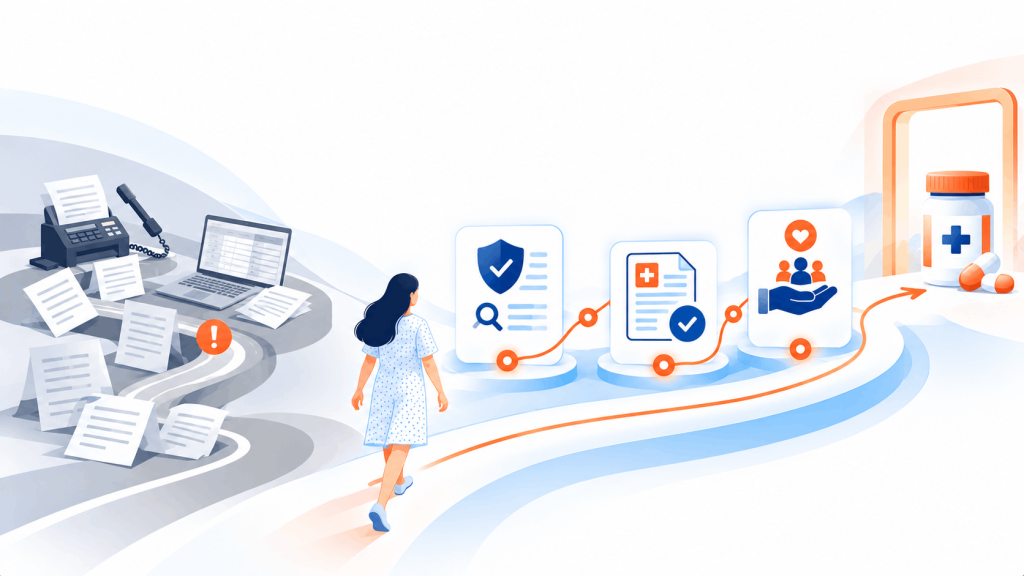
A patient may be ready to start treatment. The prescription is written, the program is available, and the healthcare provider is prepared to help. Yet the journey can still slow down because eligibility checks, prior authorization, and assistance decisions depend on manual work.
This creates a familiar question:
If the patient access program is digital, why are the next steps still happening through phone calls, faxes, spreadsheets, and follow-up emails?
Value Health eServices
help connect these steps in a faster, more structured workflow.
The goal is simple: help patients reach the right treatment pathway sooner, while giving support teams better visibility and control over the patient access journey.
The access journey starts with one question
“Is the patient covered?”
Before a patient can begin therapy, the provider or support team often needs to confirm eligibility and benefits. This may involve checking insurance details, coverage status, plan requirements, copay information, and benefit restrictions.
When this process is handled manually, teams may need to:
- Call payers or use multiple portals.
- Re-enter patient and insurance information.
- Wait for responses.
- Correct incomplete or inaccurate data.
- Follow up when information is missing.
- Repeat the process when coverage changes.
Every delay can affect the patient’s start date and the performance of the patient support program. Manual benefit verification can also place additional pressure on hub teams, field reimbursement managers, pharmacies, and provider offices.
eBV: faster answers before the next step
Value Health’s eBV solution uses AI-powered automation to retrieve and organize benefit information from multiple data sources in real time. It is designed to reduce paperwork, manual data entry, and repetitive verification work.
eBV helps teams:
- Confirm eligibility and benefits more quickly.
- Reduce errors caused by repetitive manual entry.
- Identify coverage details that may influence the next access pathway.
- Reduce administrative effort for support teams.
- Improve visibility into the patient’s benefit status.
- Scale verification as patient enrollment grows.
This means the patient is less likely to remain stuck while a support team searches for basic coverage information.
The key question changes from “How do we find the information?” to “What should happen next for this patient?”
“Does this patient need prior authorization?”
Even with active coverage, a prescription may require prior authorization (PA). Providers may need to submit clinical information, document previous treatment, or meet payer-specific criteria.
Manual PA can create delays through:
- Missing information and additional documentation requests.
- Repeated HCP follow-ups.
- Disconnected systems and manual submissions.
- Limited visibility into PA status.
- Phone and fax-based follow-up.
The impact can reach the patient. The AMA reports that 93% of physicians experience care delays linked to prior authorization, while 82% report that PA can lead patients to abandon recommended treatment.
ePA: helping move the request forward
Value Health’s electronic Prior Authorization solution helps connect the PA process from requirement discovery and information collection to submission, tracking, and next-action routing.
ePA can help:
- Reduce manual phone, fax, and paper-based work.
- Support more complete PA submissions.
- Track request status and next actions.
- Route missing information and exceptions for human review.
- Reduce repetitive follow-up across providers, plans, pharmacies, and support teams.
A faster PA process gives the patient a better chance of starting the prescribed treatment without unnecessary waiting.
“If coverage is not available, can the patient still receive support?”
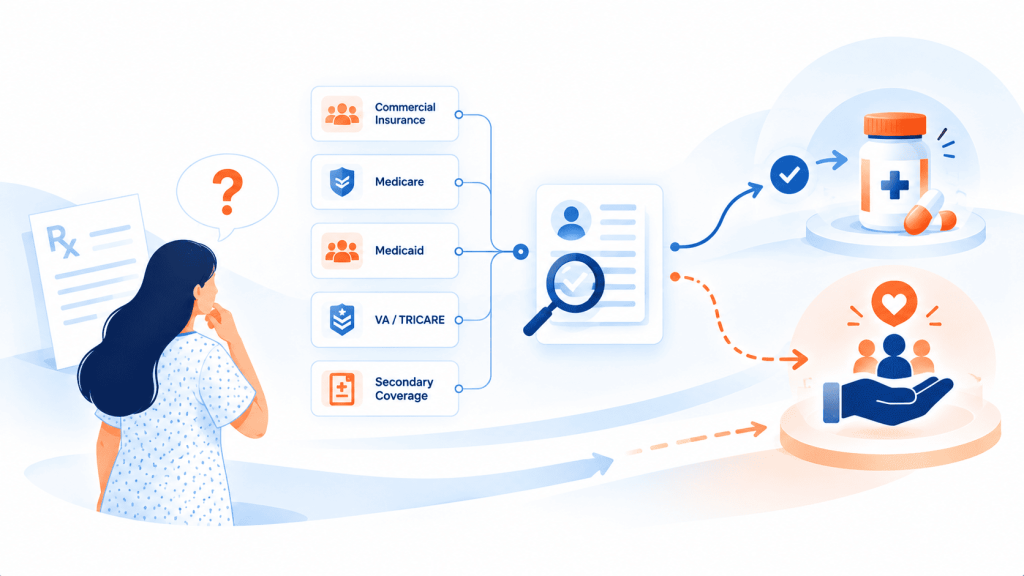
Some patients may not have usable coverage for the prescribed therapy. Others may believe they are uninsured, even though they have active commercial, Medicare, Medicaid, VA/TRICARE, or secondary coverage.
Coverage can also change after enrollment because of:
- A new job.
- Open enrollment.
- Medicaid eligibility.
- A change in insurance plan.
- Expired documents.
- A change in household income or program circumstances.
This creates an important challenge for patient assistance programs. If a patient is approved for free medication based only on older information or self-attestation, the program may miss an available insurance pathway. Conversely, if a patient’s circumstances change and the program does not recheck eligibility, the patient may experience a gap in support.
ePAP: connecting verification with assistance
Value Health’s electronic Patient Assistance Program solution connects insurance discovery, benefit verification, income screening, eligibility determination, and ongoing re-verification in one electronic workflow.
ePAP can help:
- Verify available coverage before approving free medication.
- Reduce delays caused by manual follow-up.
- Apply program rules more consistently.
- Identify newly available insurance.
- Refresh expiring documents.
- Reassess eligibility during refill cycles and annual re-enrollment.
- Help transition covered patients to the appropriate access pathway.
- Maintain continuity for patients who remain eligible.
This is especially important because eligibility does not end at enrollment. A patient’s coverage can change at any time, so an assistance program needs a way to keep the patient’s information current.
The right question is not only “Was this patient eligible when they enrolled?” It is also “Is this still the right access pathway today?”
One connected workflow for patient access
eBV, ePA, and ePAP address different access barriers but together, they help reduce manual work and keep patients moving toward therapy.
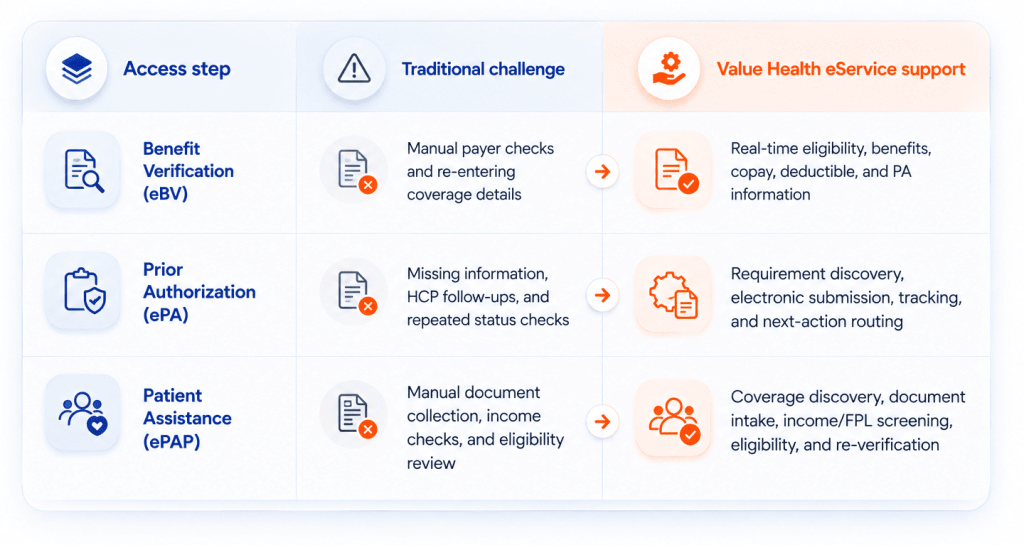
Value Health connects these workflows with hub platforms, pharmacies, HCP portals, field reimbursement workflows, Salesforce Health Cloud, and Life Sciences Cloud, giving support teams better visibility into where the patient is, what is blocking access, and what needs to happen next.
Digital should mean more than an online form
A digital patient access program should not simply move a paper form onto a screen. It should reduce unnecessary handoffs and help teams act on information quickly.
With AI and automation, teams can support:
- Faster data retrieval.
- More consistent rule application.
- Reduced manual effort.
- Better documentation.
- Clearer status visibility.
- Scheduled re-verification.
- Human review for complex or exceptional cases.
This does not remove the need for people. Instead, it allows support teams to spend less time on repetitive administration and more time helping patients, providers, and cases that need personal attention.
Helping patients get treatment on time
For a patient, the access journey may feel like a series of unanswered questions:
- Is my insurance active?
- Is prior authorization required?
- Has my provider submitted everything?
- Am I eligible for assistance?
- When can I receive my medicine?
- What happens if my coverage changes?
Value Health eServices help turn these questions into connected workflows.
eBV helps confirm the patient’s coverage and benefits.
ePA helps organize and move the authorization process forward.
ePAP helps determine whether patient assistance is appropriate and keeps eligibility aligned with the patient’s current situation.
Together, these services can help reduce administrative friction, improve program control, and support a more reliable path from prescription to treatment.
The patient access program may already be digital. The next opportunity is to make every step behind it digital, connected, and easier to act on.