


AI Is Changing How Software Is Built.
What Should That Mean for Patient Support?
Translating AI development capabilities into practical value for PSP leaders.
THE PROBLEM
AI just rewrote the rules of software. Patient support hasn't caught up.
Engineering teams now ship in weeks what used to take quarters. For the systems that power patient support programs, that shift is either the biggest operational opportunity of the decade, or a widening gap of PSP leaders can’t afford to ignore.
Somewhere this week, a development team used an AI agent to plan, write, test, and ship a feature before lunch. Somewhere else, a case manager is still toggling between five systems to confirm whether a single patient’s benefits were verified.
The pace of the software has just changed. Most of the Patient support is still running on the old clock.
Agentic AI has compressed the software development lifecycle from months to days. Code that once needed a sprint now gets scoped, built and reviewed by AI assisted teams in a single session. That shift is no longer experimental; it’s becoming the default way enterprise software gets built. AI transformation
What is happening
Development teams are embedding AI agents directly into the build process writing, testing and deploying code at a pace legacy healthcare systems were never designed to match.
Who is affected
Pharma manufacturers, hub operators, specialty pharmacies and providers who depend on PSP platforms, case management tools and CRM systems; built years sometimes decades ago.
Why it’s difficult
Healthcare cannot simply “move fast.” Compliance, data sensitivity and patient safety mean every gain in development speed must be matched by governance not traded for it.
The Hidden Challenge
The real risk isn’t that PSPs are behind technology, most have invested heavily already. It’s that faster software development is quietly raising the bar for what “good” looks like everywhere else. If build cycles shrink from months to days, patients and providers will start to expect the same responsiveness from the support programs meant to help them.
40%
of enterprise applications are projected to embed task-specific AI agents by the end of 2026 — up from under 5% in 2025.
SOURCE: GARTNER, 2026
30-35%
Improvement in patient outcomes reported by programs using AI-powered interventions vs. standard PSP approaches.
SOURCE: PMC 2021 — CITED BY ZELTHY, 2026
Problem → Friction → Consequence
Problem
AI has compressed how fast software gets built and shipped.
Friction
Legacy PSP systems and manual workflows can’t move at that pace.
Consequence
Patients, providers, and case teams absorb the delay.
Why The Problem Exists
It's rarely one broken process. It's four small gaps, compounding.
Before jumping to a fix, it’s worth naming exactly where PSP operations lose time because the same four gaps show whether the program is running benefit verification, intake, or adherence outreach.
Fragmented information
Patient, payer, provider, and pharmacy data live in separate systems that rarely talk to each other, so no single view of the patient’s journey ever exists.
Manual processes
Case managers spend hours searching, checking and re-verifying information a system should already know turning a “verified” benefit check into hidden, repeated work.
Workflow gaps
A single case can require multiple touches simply because the right information doesn’t reach the right person at the right moment in the journey.
Lack of visibility
Without a connected view across the program, leaders can’t see where cases stall, where SLAs slip, or where the next bottleneck is forming.
The Impact — A Chain Reaction
Fragmented data → Manual work → Slower decisions → Operational inefficiency → Poorer experience
What if the problem isn't the amount of information PSPs have, but how is that information accessed and used?
The Solution
The same shift changing software is the shift PSPs need next.
Agentic development didn’t win by adding more engineers or more documentation. It won by connecting context, applying intelligence, and acting on it immediately. Patient support can apply to the same operating model.
The old framing
Organizations need more data
The shift
Organizations need smarter ways to turn the data they already have into actionable, in-the-moment information.
How the shift works
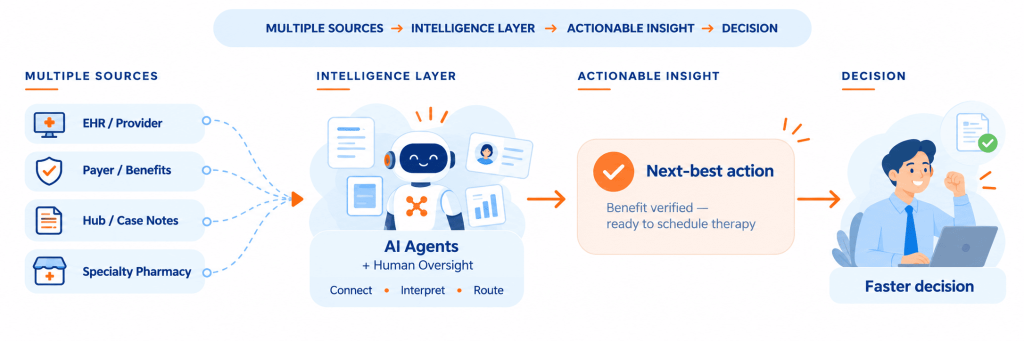
01 – CONNECT
Unify the sources
Bring patient, payer, provider and pharmacy information together into one connected operating layer.
02 – UNDERSTAND
Apply intelligence
AI agents read intake documents, verify benefits and interpret case signals with human oversight built in.
03 – SURFACE
Deliver the moment
The right information reaches the right person in case of manager, provider, or patient exactly when it matters.
04 – ACT
Decide faster
Teams move from searching for answers to acting on them, shortening time to therapy across the program.
- Speed without governance is just a risk in a hurry.
- AI should remove the search, not the safeguards.
- Every faster decision still needs a human in the loop.
The Impact
So, what changes?
Key outcomes
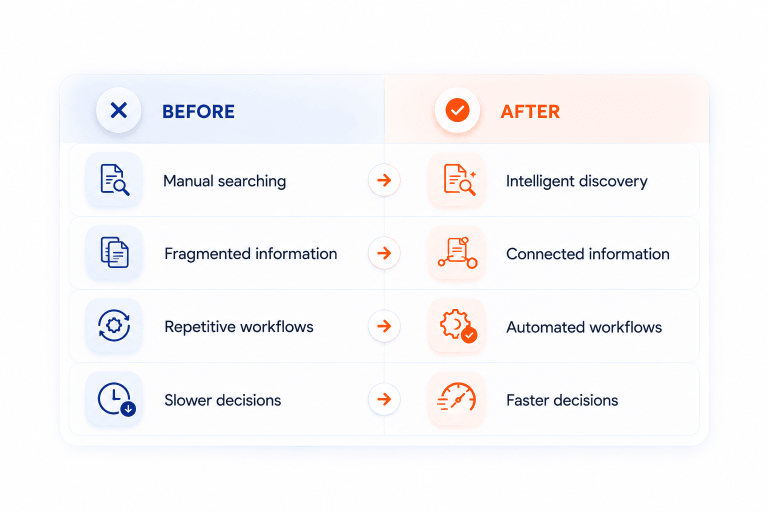
Faster decisions
Reduce the unnecessary time case teams spend searching for information that already exists somewhere in the system.
Lower operational burden
Automate the repetitive verification and data-entry work that quietly consumes a case manager’s day.
Better visibility
Give program leaders a complete, real-time picture of where every case stands and where it’s likely to stall next.
Improved experience
Help patients, providers and case teams move through the journey with noticeably less friction at every step.
The future isn't about adding more information. It's about making the right information easier to act on.
Ready to rethink the workflow?
Explore how AI-first, human assured operating models can shorten time-to-therapy and give your PSP team a real-time view of every case.
Explore PSP Solutions →