


Growth shouldn’t require more systems, more manual work, and more people to hold everything together.

Five years ago, the practice had 40 providers. Today, it has more than 100, multiple locations, several specialties, and a patient population that continues to grow. By almost every traditional measure, the organization is successful.
But inside the business office, success has created a different reality. The systems and processes that worked when the organization was smaller are beginning to strain. Patient information lives in multiple places. Referrals and enrollment information arrive through different channels. Staff members move between payer portals, process faxes, verify benefits, track prior authorizations, follow up on missing documentation, communicate with patients, and manually update systems along the way.
When a patient calls for an update, finding the answer isn’t always simple. Someone may need to check one system for insurance information, another for authorization status, and an email or call log to understand the last interaction with the patient. The organization has invested in technology, but its employees are still doing much of the work required to connect with that technology.
The organization has grown. The infrastructure underneath it hasn’t.
This is the point many medium-sized healthcare organizations eventually reach. They are too large and complex to continue operating through disconnected systems and manual processes, but the traditional alternative can mean an expensive enterprise CRM, extensive customization, lengthy implementation, and another technology platform that employees must learn and manage.
Value Health built Medivo 360 for that gap.
Medivo 360 is a new AI-native healthcare CRM designed to bring the patient journey, administrative workflows, data, teams, and AI-powered automation together in one connected environment. Rather than simply giving healthcare organizations another place to store patient information, Medivo 360 is designed to understand the work surrounding that information and help move it forward. Its capabilities span enrollment, benefit verification, prior authorization and appeals, adherence and appointment workflows, patient and HCP engagement, business rules, team allocation, reporting, and more.
For a growing healthcare organization, that’s an important distinction. You don’t necessarily need another system to manage. You need a system that can help manage the work.
The Hidden Operational Cost of Growth
Healthcare organizations rarely realize the exact moment they’ve outgrown their systems. It happens gradually. A new location opens. Patient volume increases. Another specialty is added. A payer introduces a new requirement. Someone creates a spreadsheet because the existing system can’t track a particular process. Another point solution is purchased to solve a different problem.
Each decision makes sense individually. Over time, however, the patient journey becomes fragmented across systems, portals, spreadsheets, inboxes, phone calls, faxes, and departments.
The consequences show up everywhere. Staff spend more time searching for information. Cases sit in queues because the next person doesn’t know they’re ready. Missing documentation isn’t discovered until someone manually reviews the case. Managers have difficulty seeing where bottlenecks are forming. Patients call because they don’t know what’s happening, which creates even more administrative work for the staff trying to help them.
Eventually, growth begins creating administrative complexity almost as quickly as it creates revenue. The organization’s solution is often to add people. Another coordinator handles the growing queue. Another employee manages authorizations. Another person processes incoming documentation.
The business is scaling, but so is the administrative burden.
Medivo 360 is designed to help break that relationship
What If Your CRM Didn’t Just Track Work, But Helped Do It?
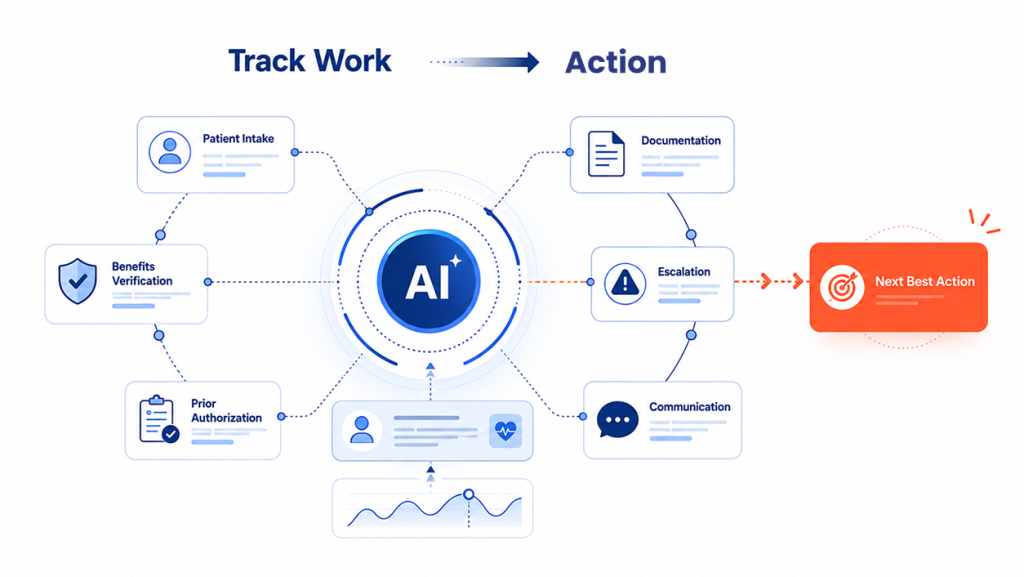
Traditional CRM systems are very good at storing and organizing information. Healthcare organizations need something more.
Consider the questions employees have to answer throughout a patient’s journey. Is the intake complete? Is something missing? Have benefits been verified? Does the payer require prior authorization? Does this case need to be escalated? Who should handle it? What needs to happen next?
In many organizations, a person answers every one of those questions.
Medivo 360 introduces an intelligence layer directly into the workflow. Its Next-Best-Action Engine is designed to recommend the appropriate task based on the patient and program in real time. An interactive AI guide can help users work through their queues and tasks, while intelligent automation can triage documents, draft communications, and close routine steps without requiring the same level of manual intervention.
That changes what a CRM can be.
Instead of simply documenting what happened yesterday, Medivo 360 can help teams determine what should happen next.
One Patient Journey Instead of a Series of Handoffs
Consider what happens when a new patient enters a specialty practice. The referral or intake is received, documentation is reviewed, insurance information is collected, benefits are verified, payer requirements are evaluated, prior authorization may need to be initiated, financial support options may need to be explored, and the patient needs to be kept informed throughout the process.
In a fragmented environment, each of those steps can become its own workflow, with information moving between people and systems along the way. Every handoff takes time, and every handoff creates another opportunity for the patient to stop moving forward.
Medivo 360 brings those activities into a connected patient journey. Guided intake can capture documentation and identify missing information. Benefit verification, prior authorization, and appeals can be orchestrated within the workflow. Business rules can be applied dynamically, while work can be routed based on roles and skills. Patient and provider communications can be tracked as part of the same journey.
Most importantly, the system can use the information generated at one stage to help determine what should happen at the next.
That’s very different from simply digitizing a manual process.
It’s about creating a workflow that becomes more intelligent as the patient moves through it.
AI That Is Part of the Platform, Not Added to It
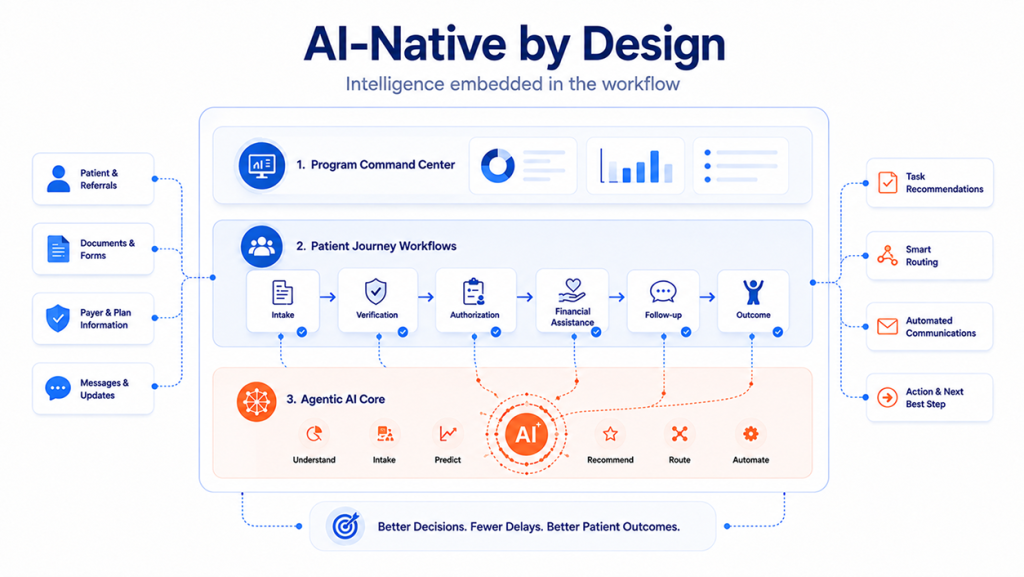
There are plenty of AI tools being introduced into healthcare. But adding an AI assistant to a fragmented technology environment doesn’t necessarily solve the underlying fragmentation.
Medivo 360 was designed differently. Value Health describes the platform as AI-native by design, with intelligence embedded into the workflows rather than added as a separate layer later. The platform combines a program command center, patient journey workflows, and an agentic AI core that can recommend, guide, route, and automate work.
That means AI isn’t simply something an employee can choose to use. It can become part of how the work itself moves.
When documentation arrives, the opportunity isn’t simply to store it digitally. AI can help triage it. When a case changes, the opportunity isn’t simply to update a status field. The platform can help determine the next appropriate action. When a manager needs insight into operations, reporting and dashboards can provide greater visibility into what’s happening across the program.
For medium-sized healthcare organizations, this can be particularly important. Many don’t have enormous IT teams or armies of developers available to continuously customize their technology. They need sophisticated capabilities without creating another layer of operational complexity.
Enterprise Capability Without the Enterprise Burden
For years, growing healthcare organizations have faced an uncomfortable choice. Continue stretching systems that were never designed for their current scale, or move toward a traditional enterprise CRM that can require significant customization and ongoing technical resources.
Medivo 360 creates another option.
The platform is designed around configuration rather than rebuilding workflows from scratch. Value Health’s underlying model is “configure, don’t code,” allowing rules and workflows to be adapted as needs change. The platform is also designed to support multiple types of programs on the same foundation rather than creating separate technology environments for each new use case.
That flexibility matters because healthcare doesn’t stand still. Payer rules change. Programs change. Patient populations change. Organizations add services and locations. A system that requires a major technology project every time the business changes eventually becomes part of the problem.
Medivo 360 was built to evolve with the organization.
Give Your Teams One Connected View
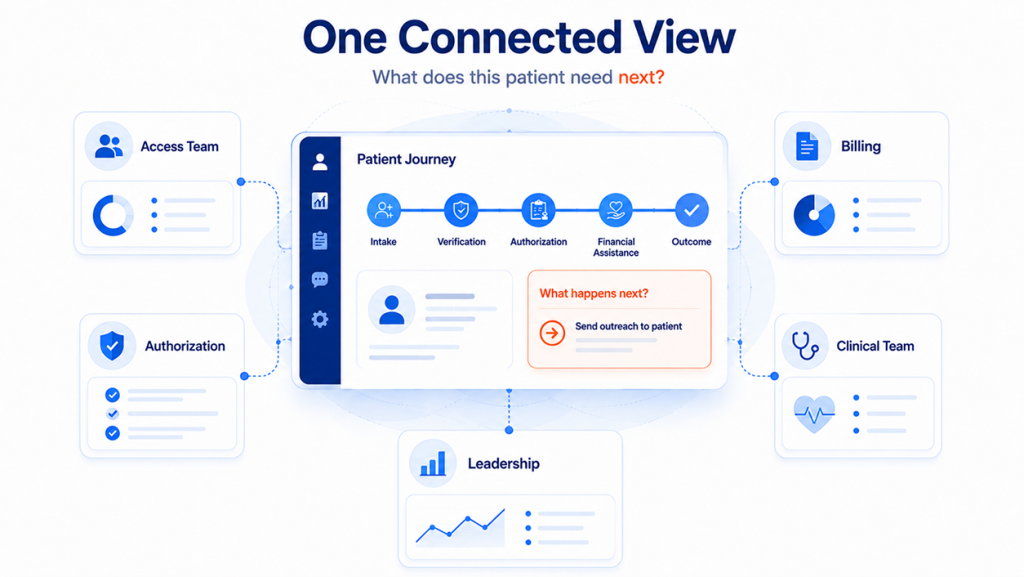
There is another cost to fragmented systems that is harder to quantify: no one sees the same patient journey.
The access team sees one part. The authorization team sees another. Billing has another view. Clinical teams have theirs. Leadership often sees what happened only after someone generates a report.
Medivo 360 is designed to bring those pieces together. In addition to configurable patient workflows, the platform includes native account management, proprietary formulary and drug data, and integrations with affordability platforms.
The objective is a more complete view of the patient and the work surrounding them, so teams don’t have to spend their time reconstructing that journey from disconnected sources.
Instead of asking, “Who knows what’s happening with this patient?” an organization can begin asking the more important question: “What does this patient need next?”
And Medivo 360 can help answer it.
Your Organization Has Changed. Your CRM Should Too.
For years, healthcare organizations have accepted a fairly simple equation: more patients create more administrative work, and more administrative work requires more people.
That equation is becoming increasingly difficult to sustain.
The opportunity with AI isn’t simply to make existing administrative tasks a little faster. It’s to rethink which tasks need to be performed manually in the first place.
That’s why Value Health built Medivo 360.
It is a new kind of healthcare CRM designed for organizations that have reached the limits of disconnected systems and manual workflows but don’t want to take on the cost and complexity of a traditional enterprise transformation.
Medivo 360 brings patient workflows, operational data, business rules, communication, automation, and AI together in one healthcare-focused platform. It gives teams the tools to manage the patient journey while providing an intelligence layer that can recommend actions, guide users, automate routine work, and help keep cases moving forward.
For a medium-sized healthcare organization, that can mean fewer manual handoffs, less dependence on spreadsheets and disconnected systems, greater visibility for leadership, and more capacity to grow without administrative headcount growing at the same pace.
Your organization shouldn’t have to choose between technology it has outgrown and technology that’s too complicated to own.
There is another option.
Medivo 360 gives growing healthcare organizations the capabilities of a modern, AI-native CRM built around the way healthcare actually works.
Because the next stage of growth shouldn’t require more people to hold your systems together.
It should require a better system.
Ready to take the next step and explore how Medivo 360 can help you scale?
Visit us at www.valuehealthai.com or contact us at info@valuehealthsol.com