


Gap Between Strategy & Execution in SDLC
Almost all SDLC begins with optimism.
A healthcare organization approves a digital transformation initiative. The leadership team aligns around a shared vision. Budgets are approved, vendors are selected, and project timelines are agreed upon.
Everyone believes the new solution will improve operations, reduce manual effort, and ultimately deliver better experiences for patients and care teams.
The first few weeks move quickly. Requirements are gathered, workshops are completed, and development begins.
Then reality sets in.
A payer changes its requirements. Operations identify a new workflow that wasn’t part of the original design. Compliance requests additional validations. Another system needs to be integrated before the solution can go live.
Weeks turn into months.
While the software is still being built, the business has already moved on. Teams develop temporary workarounds. Users continue relying on spreadsheets and emails. The original problem remains unsolved but not because the organization lacked a strategy, but because software delivery couldn’t keep pace with business change.
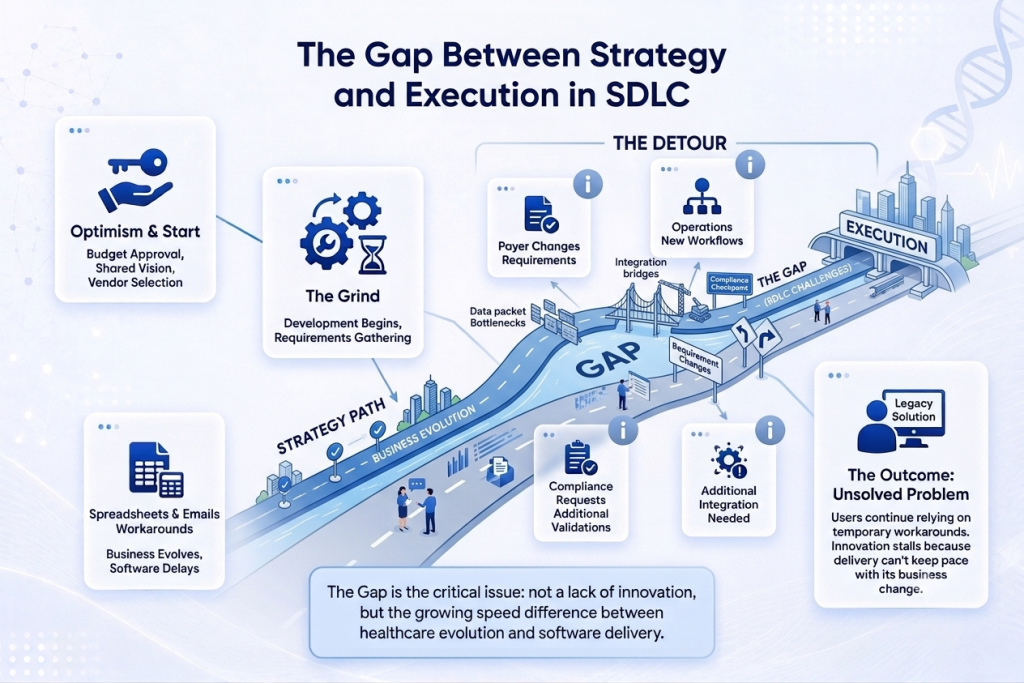
This story isn’t unique to one organization. It’s playing out across healthcare every day.
The challenge isn’t a lack of innovation. It’s the growing gap between the speed at which healthcare evolves and the speed at which software is delivered.
SDLC was Built for Stability. Today’s Businesses Need Agility.
For decades, the Software Development Life Cycle (SDLC) has been the foundation of enterprise software delivery. It introduced discipline through planning, development, testing, deployment, and maintenance, helping organizations build reliable software in a structured way.
That approach worked well when business requirements remained relatively stable. But today organizations operate in an environment where customer expectations, regulations, market conditions, and technology evolve continuously.
A project that begins with a clear set of requirements often reaches development only to discover that priorities have shifted. By the time testing is complete, new workflows, integrations, or compliance needs have emerged. Teams find themselves spending as much time adapting to change as they do build new capabilities.
Traditional SDLC isn’t failing. Business is simply moving faster.
Why Move From Traditional SDLC to AI SDLC?
The common challenges are familiar:
-
- Lengthy development and release cycles
-
- Frequent requirement changes and rework
-
- Repetitive development and testing effort
-
- Growing technical debt and maintenance costs
Organizations are no longer asking how to build software. They’re asking how to deliver business outcomes faster.
Healthcare Feels These Delays More Than Most Industries
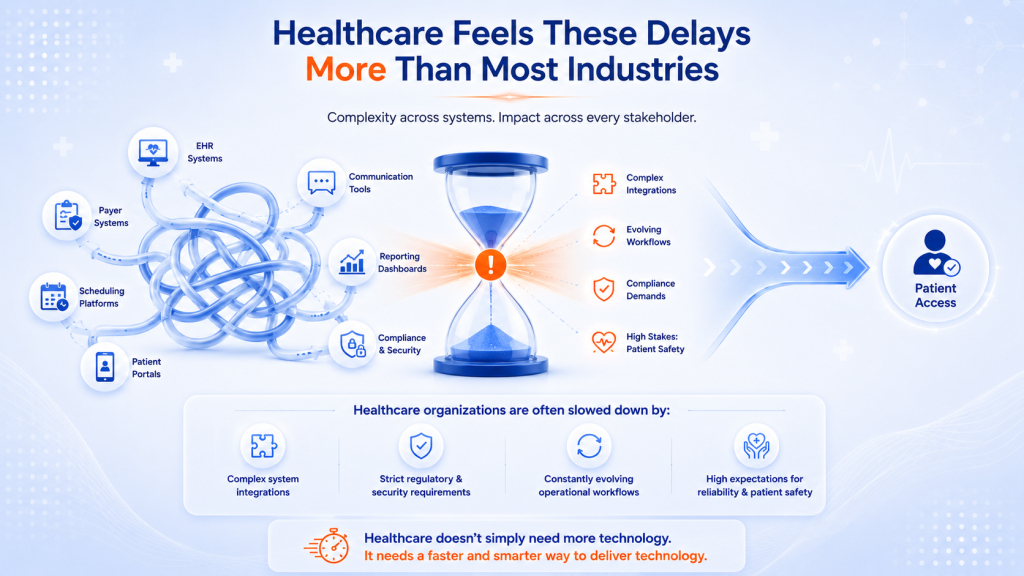
Every industry depends on technology, but healthcare depends on technology that must work together.
A new workflow isn’t simply another software feature. It affects clinicians, operational teams, patients, providers, payers, and compliance. Something as straightforward as digitizing referral intake can require changes across EHRs, payer systems, scheduling platforms, patient portals, reporting dashboards, and communication tools.
The complexity isn’t just technical. It’s operational.
Every integration requires validation. Workflow must meet compliance standards. Release must protect patient data while ensuring that care delivery isn’t disrupted.
This is why healthcare software projects often take longer than expected. The challenge isn’t writing code but coordinating an ecosystem where every system, workflow, and stakeholder depends on one another.
Healthcare organizations are often slowed down by:
-
- Complex system integrations
-
- Strict regulatory and security requirements
-
- Constantly evolving operational workflows
-
- High expectations for reliability and patient safety
Healthcare doesn’t simply need more technology. It needs a faster and smarter way to deliver technology.
PSP Raise the Stakes Even Higher
The challenge becomes even greater inside Patient Support Programs (PSPs), where technology directly influences how quickly patients begin therapy.
Consider a pharmaceutical company preparing to launch a new therapy. Clinical milestones have been achieved, commercialization plans are in place, and vendors have been selected. On paper, everything appears ready.
But operationally, there is still work to be done.
Referral intake workflows need configuration. Benefit verification rules must be implemented. Prior authorization processes require payer-specific logic. CRM platforms need integration with hub operations, specialty pharmacies, field reimbursement teams, and patient engagement channels.
Each component may work independently, but unless they function as one connected workflow, the patient journey stalls.
A delay in one process often creates delays across several others. An incomplete benefit verification can postpone prior authorization while a disconnected CRM can slow provider communication. Similarly, Limited workflow visibility can leave case managers, FRMs, and call center agents working with different versions of the same patient story.
Common PSP delivery challenges include:
-
- Building similar workflows for every new therapy launch
-
- Integrating multiple vendors and healthcare platforms
-
- Adapting quickly to changing payer and reimbursement rules
-
- Maintaining visibility across the end-to-end patient journey
In Patient Support Programs, software delivery is not just an IT initiative but it becomes a critical part of patient access. Every workflow delivered faster has the potential to remove barriers, improve coordination, and help patients begin therapy sooner.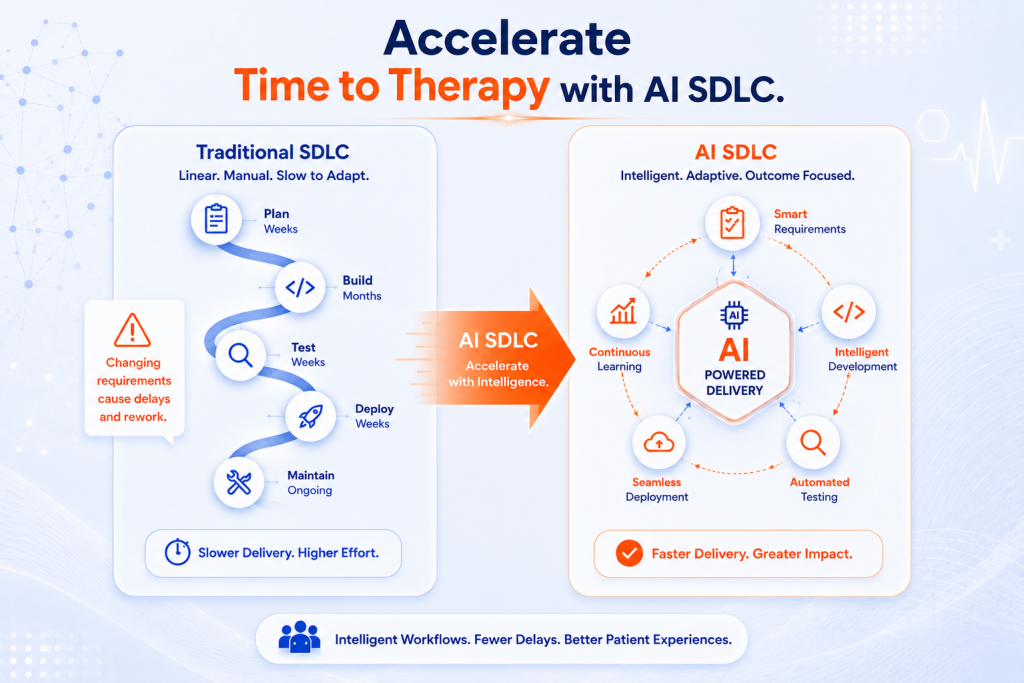
The Real Problem Isn’t Software. It’s Execution.
Healthcare doesn’t suffer because engineers aren’t talented. However, it is because engineers spend too much time rebuilding similar workflows.
Every PSP launch often recreates:
-
- APIs and Integrations
-
- Forms and Workflow Logic
-
- Testing and Documentation
AI SDLC changes this.
Not by replacing engineers. By helping them reuse what already exists and build faster.
Healthcare’s Hesitation Around AI Is Healthy
Healthcare isn’t resisting AI. Healthcare is protecting patients.
Why the hesitation?
-
- HIPAA
-
- Auditability
-
- Clinical accuracy
-
- Human validation
-
- Explainability
The question isn’t whether healthcare will adopt AI. It’s how responsibly it will do it.
AI SDLC Is About Better Engineering; Not Less Engineering
AI Assists With
-
- Requirements
-
- Documentation
-
- Testing
-
- Code Suggestions
-
- Integration
-
- Regression Testing
-
- Release Notes
Humans Still Own
-
- Architecture
-
- Business Decisions
-
- Security
-
- Clinical Validation
-
- Compliance
Building the Next Generation of Healthcare Delivery
Organizations won’t differentiate themselves because they adopted AI.
They’ll differentiate themselves because they learned to deliver healthcare software faster, with better governance and fewer operational delays.
At Value Health, we believe AI should accelerate healthcare execution and not replace healthcare expertise.
Our AI Transformation practice combines healthcare domain knowledge, reusable accelerators, AI-assisted engineering, and workflow expertise to help organizations modernize patient access, PSPs, CRM platforms, and operational workflows with greater speed and confidence.
See How Value Health makes AI SDLC adaptability easier for Healthcare