


Where specialty drug access slips between benefit verification, prior authorization and patient assistance.

"Approved", but Still Waiting
The insurer approved an oral cancer specialty medication. The patient was told it would arrive within days.
A week later, the patient called the clinic: “Has it shipped?”
The clinic checked. The prescription had gone to the specialty pharmacy and was marked “sent.” The pharmacy checked too. It had the prescription, but not the approval sitting in the clinic’s system, so a technician started verifying coverage again.
The approval was complete. The patient journey wasn’t.
Nobody made a bad decision. The payer had answered. The delay lived in the handoff.
The Patient Journey Has a Handoff Problem
Picture a busy restaurant. The kitchen finishes a dish in record time, but the ticket for table twelve never reaches the server. The plate waits under the heat lamp. The kitchen did its job. The guest is still hungry.
Specialty drug access works the same way. A task can be completed quickly and the patient still waits, because completing a task is not the same as moving its result to the team that acts next. The patient doesn’t experience departments. The patient experiences the entire process.
Here is the journey, with a handoff at every arrow:

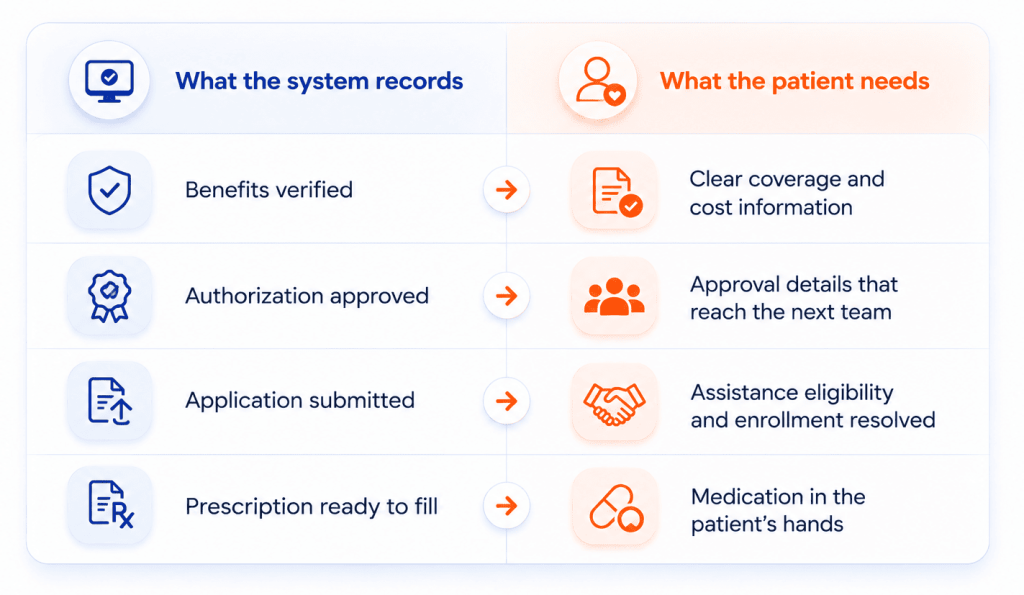
Patient assistance, when needed, runs in parallel with handoffs of its own. At each arrow, a result can be recorded in one system and never reach the next team. That is the gap between what a system shows and what a patient needs:
Three Critical Steps. Three Opportunities for Delay.
Electronic Benefit Verification
When Coverage Information Doesn't Travel
The team’s goal is simple: confirm what the plan covers. That means insurance eligibility, medical and pharmacy benefits, formulary status, copays and deductibles, and whether prior authorization is required.
The trouble starts when the answer stays behind. A “verified” flag doesn’t say what was checked or when, so the next team, a hub or a specialty pharmacy, verifies again. The patient waits through repeated checks and still can’t get a clear answer on cost.
This is where Value Health’s electronic benefit verification fits. It returns eligibility, copay, deductible, coverage and prior authorization requirements, with medical and pharmacy benefit details in one view. The next team starts from a result, not a repeat.
Electronic Prior Authorization
When Approval Doesn't Reach the Next Team
Prior authorization has its own moving parts: payer-specific criteria, step therapy rules, clinical documentation and constant status checks. A missing chart note, or a payer request for more information that lands in one inbox, can quietly stall a case.
Submitting electronically helps, but it isn’t enough. Someone still has to chase the missing piece, watch the status and make sure the decision reaches the team arranging delivery. An approval nobody acts on is just a document.
Value Health’s electronic prior authorization is built around that follow-through. When benefit verification identifies a requirement, the workflow can surface payer criteria, route missing information to the prescriber’s office by web form, fax, email or phone, monitor status every eight hours and return approval or denial details with next actions.
Electronic Patient Assistance Program Enrollment
When Documentation Delays Financial Assistance
When cost is the barrier, patient financial assistance may help eligible patients. But enrollment needs consent, income documents and signatures, and each year re-enrollment brings the work back. When the clinic assumes the hub holds the paperwork and the hub assumes the clinic does, a missing signature becomes a stalled patient.
Value Health’s electronic patient assistance program enrollment starts earlier in the chain. It discovers and verifies available coverage before an eligibility decision, then supports digital consent, document intake and income screening against program rules. Incomplete or low-confidence cases go to trained human reviewers, and coverage is rechecked at re-enrollment.
These steps feed each other. A thin verification becomes an incomplete authorization request, which becomes a delayed assistance application.
Faster Verification, Slower Therapy
A University of Kentucky HealthCare study shows how a fast step can sit beside a slow journey. Researchers compared specialty prescriptions filled by the health system’s own pharmacy with those transferred to outside specialty pharmacies.
Kentucky study: average days
Filled in-house: 10 days from provider order to ready-to-fill, then 2 days to patient receipt. 12 days combined.
Transferred outside: 6 days to ready-to-fill, then 12 days to patient receipt. 18 days combined.
Transferred prescriptions were ready sooner, yet the stretch from ready-to-fill to patient receipt ran 10 days longer. “Ready to fill” is a milestone inside the pharmacy. “Received” is what the patient lives.
A fair caution: this was a retrospective, propensity-matched study at one health system, covering July 2021 to July 2022. It does not prove that handoff failures caused the gap. It does show that a prescription can be ready sooner and still reach the patient later. Read the study.
One Day at the Payer. Then What?
Payers do take time, but less than many assume. KFF’s analysis of 2025 insurer data found median response times of about one day for standard prior authorization requests across the markets reported. Those figures cover medical items and services and exclude prescription drugs, so they are not a drug benchmark. A median can also hide slower cases.
The point is narrower: payer response time is one part of the timeline. Inside the practice, the AMA reports that physician practices complete an average of 39 prior authorizations per physician each week. Its 2024 survey puts the related workload at about 13 hours of physician and staff time weekly.
That 13 hours is self-reported, and not all of it is avoidable or caused by handoffs. But repeated documents, status calls and manual follow-ups sit inside it.
The Hidden Cost of Patient Access Delays
Disconnected workflows rarely show up as one line in a budget. They show up as effort and uncertainty:
- Repeated work. Skilled people re-verify what someone else already verified.
- Invisible delay. Each team reports its own tasks as complete, so the time between teams appears on no dashboard.
- Unclear ownership. Nobody owns the space between systems, so nobody fixes it.
- Hard-to-justify technology. Without visibility, it is difficult to show where an investment would help.
- A worse patient experience. Patients get inconsistent answers and wait longer for time-to-therapy.
Scale makes it worse. Imagine a program where a coordinator chases status on 50 cases a month by phone and spreadsheet. It works. At 5,000 cases across several programs, the same habit becomes a structural problem, because no one can see where cases are waiting.
What a Better Patient Access Workflow Looks Like
A stronger patient access workflow should do a few things well:
- Carry one current verification result forward, with its source and date
- Show where each case stands: sent, received, approved, started
- Automate routine information processing and flag what is missing
- Bring in people for exceptions that need judgment
- Name an owner for every handoff
If that list sounds basic, it is. Most delays survive because these basics sit in different systems.
How Value Health Addresses the Handoffs
Value Health’s approach is AI-Led. Human-Assured. In practice: technology handles routine information processing and helps identify missing information and organize Next Best Actions. Experienced people stay involved where cases are complex, incomplete or ambiguous. Technology should support better decisions, not replace appropriate human judgment.
Here is how that maps to the handoffs above:
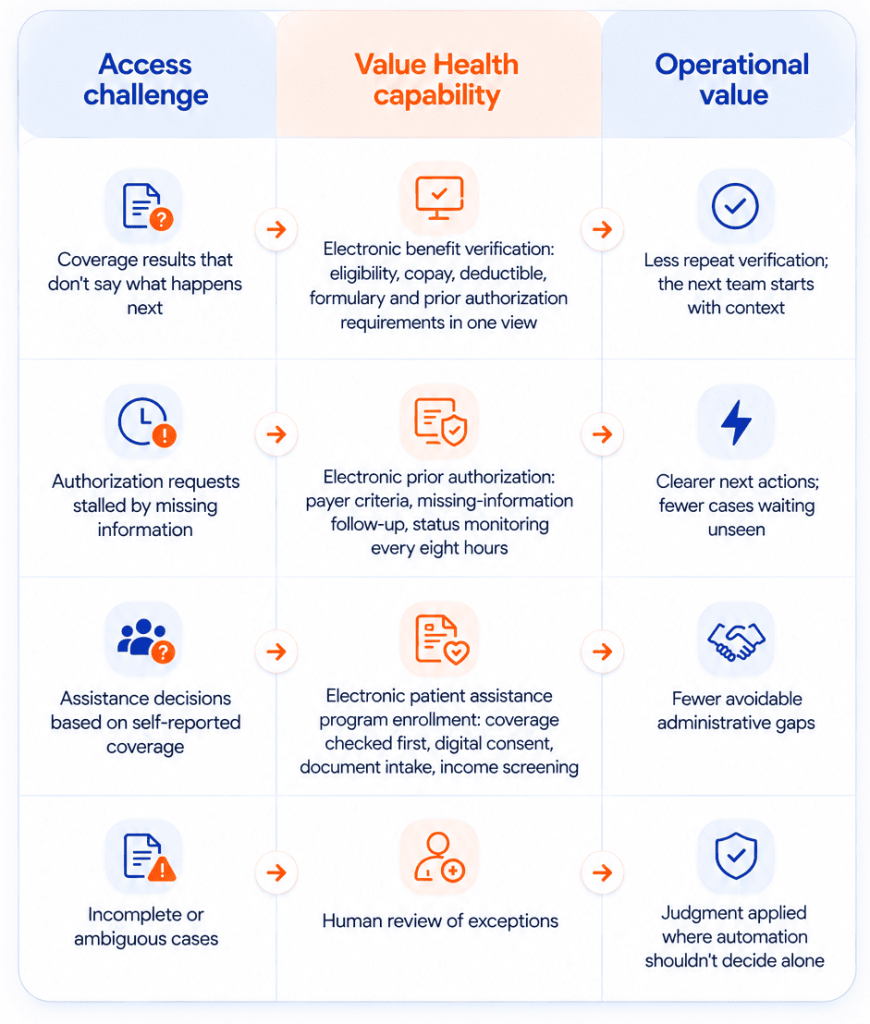
As Value Health describes them, the capabilities connect where it matters: a benefit verification result can start the prior authorization workflow, and benefit verification is built into assistance eligibility. None of this removes every delay. It aims to stop information from getting lost on its way to the next team.
From Approval to First Dose
Go back to the oral cancer patient. The payer had done its part. The patient was still waiting because the approval never reached the team that needed it.
So how does your organization measure patient access? By tasks completed, or by medication received?
Pick one prescription and trace it from order to first confirmed dose. Note where it waited, who owned the next action and what information was missing. That is the handoff to fix first.
An approval is not a delivery date.