
How Value Health’s AI-Powered eBV and Intelligent Reverification Are Transforming Patient Access in PSP Programs
Two of the most operationally critical workflows in any Patient Services Program share a common flaw. Electronic Benefit Verification (eBV) and Annual Reverification were each designed to answer a question. Is this patient covered? Has anything changed? But in most PSP environments today, answering those questions has become the end goal rather than the beginning of a workflow.
The result is a system that confirms coverage without moving cases forward and reverifies patients without distinguishing between those who need urgent intervention and those who are stable. Speed and volume have become the metrics of success, when the only metric that truly matters is whether the patient reaches therapy.
This article examines the operational gaps in how PSP teams currently approach benefit verification and reverification, and how Value Health AI’s integrated platform is redefining both as engines of workflow intelligence rather than isolated compliance tasks.
The eBV Gap: When Half-Clear Coverage Creates Full Patient Access Delays
Electronic Benefit Verification has transformed how quickly PSP teams can retrieve coverage information. What once required extended phone queues with payers can now return results in minutes. But speed of retrieval has created a false sense of operational progress, because faster verification does not automatically mean faster patient access.
The deeper problem is structural. Medical and pharmacy benefits are most often reviewed separately, by different teams, through different workflows, and frequently on different timelines. A patient can have medical benefits confirmed while pharmacy benefit remains pending. A coverage pathway can be partially clear while the other remains unresolved. In that gap, patient progression stalls.
Half-clear coverage creates full patient access delays.
PSP teams operating without unified benefit visibility are forced to manage fragmented information across disconnected workflows. Therapy progression slows not because verification failed, but because the benefit intelligence that was retrieved could not drive a clear next action. The case sits in a state of partial resolution, consuming staff time and delaying the patient.
The salient points that define this challenge across PSP programs today include:
- Medical and pharmacy benefits are routinely reviewed through separate, disconnected workflows
- PSP teams lack unified benefit visibility across both pathways simultaneously
- Therapy progression slows when one coverage pathway remains unclear or unresolved
- Faster verification turnaround times do not resolve workflow fragmentation
- Manual follow-up to reconcile fragmented benefit data adds days to patient onboarding
Annual Reverification Is Not Outcome. Therapy Progression Is.
Many point solutions in the market compete on verification speed. Faster turnaround times. Higher automation rates. Reduced call volume. These are real improvements, and they matter. But they address only the first step of a much longer workflow and optimizing the first step while leaving the rest fragmented does not move patients closer to therapy.
The challenge PSP teams face is not just confirming that a benefit exists. It is translating that benefit intelligence into a clear, actionable next step. What does this coverage mean for this patient on this therapy? What payer-specific requirements apply? What needs to happen next, and who needs to do it?
Verification is not the outcome. Therapy progression is.
When benefit verification operates as an isolated task rather than the first trigger in a connected workflow, teams receive data without direction. Cases accumulate without resolution. And patients wait longer than necessary for access to the therapy they need.
The operational gaps that result from treating verification as an endpoint rather than a workflow trigger include:
- Benefit results that confirm coverage but do not route cases toward next actions
- Escalation decisions left to individual agent judgment rather than intelligent workflow logic
- Payer-specific requirements and formulary risks that are not surfaced at the point of verification
- Manual handoffs between verification and downstream PA, BV, and financial assistance workflows
- Operational friction that compounds as case volume grows
The Reverification Problem: Rechecking Every Patient the Same Way
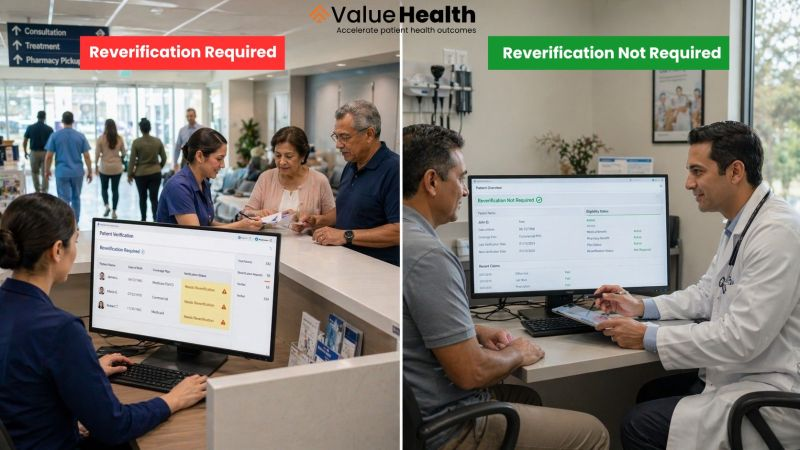
Annual reverification faces a different but equally consequential operational challenge. Most PSP teams apply reverification workflows broadly across their entire patient population, treating every patient as equally likely to experience a coverage disruption. The result is operational overload that consumes significant staff time on patients who are stable, while intervention-ready cases may not receive the attention they need.
Not every patient carries the same risk profile heading into a new benefit year. Some patients are on stable payer relationships with consistent formulary positioning. Others face a convergence of risk factors that make therapy disruption significantly more likely. Applying the same level of review to both populations is not thoroughness. It is inefficiency at scale.
The problem is not reverification. The problem is reverifying everyone equally.
Modern PSP reverification requires evaluating a much broader set of variables than a simple payer check. The factors that can disrupt therapy access for a patient are numerous and interconnected:
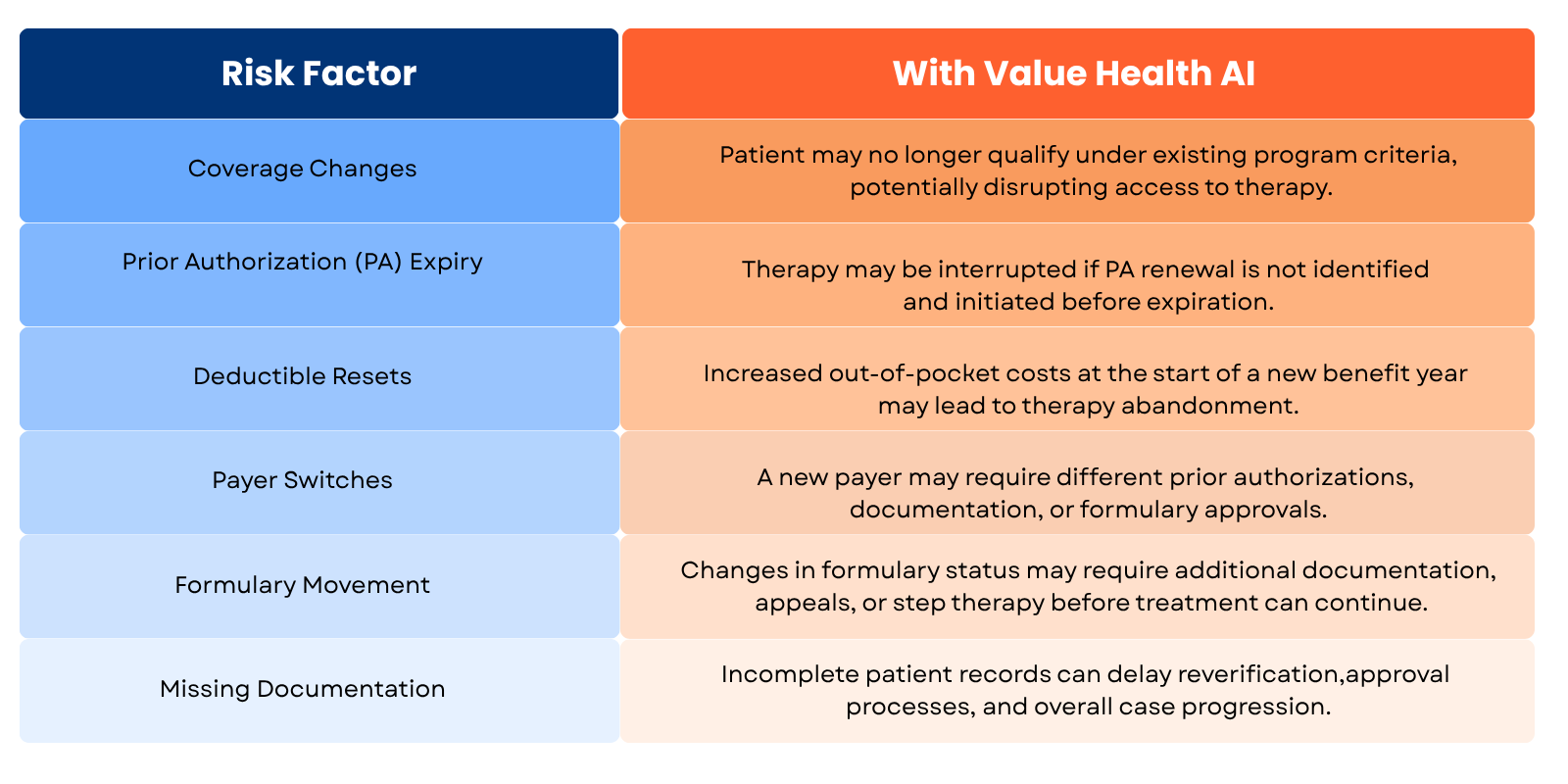
When PSP teams cannot distinguish between stable patients and those facing one or more of these risk factors simultaneously, the entire population moves through reverification at the same pace. Stable patients consume time that should be directed toward intervention-ready cases. Backlogs build. And the patients most at risk of therapy disruption are the least likely to receive proactive outreach in time.
Industry Reality: The Data Behind the Workflow Gap
These are not isolated program challenges. They reflect systemic conditions across the PSP industry that make the case for intelligent, connected verification and reverification workflows both urgent and compelling:
- Fragmented workflows across email, fax, portals, and disconnected systems remain the norm for benefit verification in most PSP environments, creating manual reconciliation burden at every step.
- Volume-driven reverification means teams spend a disproportionate share of their capacity reviewing low-risk patients while high-risk cases compete for the same limited attention.
- Manual follow-up loops triggered by incomplete benefit data or missing documentation create backlog pressure that slows case progression across the entire patient population.
- Up to 35% of healthcare staff time is spent on administrative tasks, including benefit-verification workflows and post-verification documentation that could be automated.
- Direct therapy impact delays in benefit verification and reverification directly affect therapy initiation and continuity timelines, making workflow intelligence a patient outcomes issue, not just an operational one.
eBV Is Evolving: From Verification to Workflow Intelligence
Traditional eBV was designed to verify benefits. That was the entire scope of the solution, and for many years it was sufficient. But the operational demands of modern Patient Services Programs have outgrown what point-in-time verification can deliver.
The shift that is now underway across leading PSP operations is from verification as a task to verification as a workflow trigger. The benefit data retrieved through eBV is not just confirmation. It is the first and most information-dense signal in a patient’s program journey, and AI is now capable of acting on that signal in ways that were not previously possible. 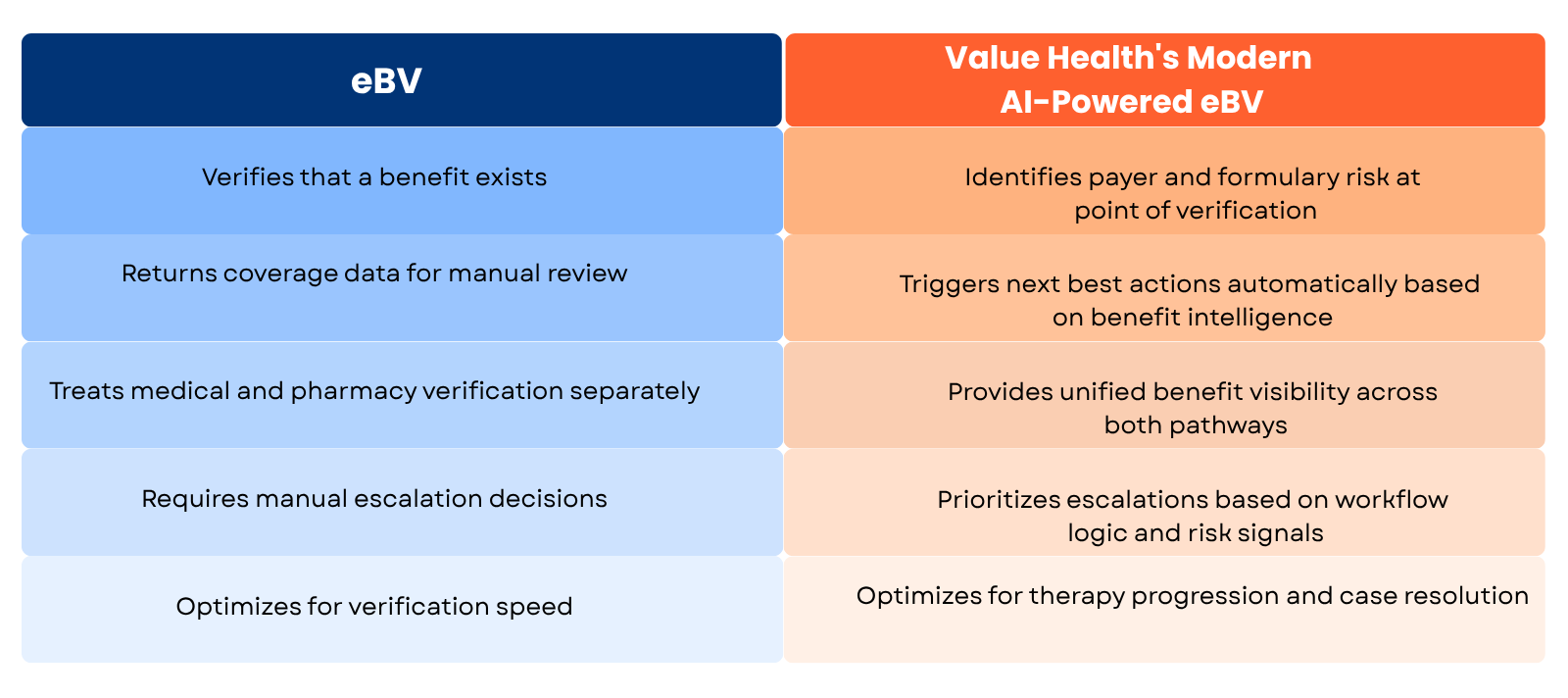
Modern eBV should do more than confirm coverage. It should move workflows forward.
The same evolution applies to reverification. The question is no longer how quickly a team can reverify its patient population. It is which patients require immediate intervention, and how can the reverification process identify them faster and route cases to the right teams before therapy is disrupted.
Value Health AI Has a Solution: Intelligent eBV and Reverification Workflows
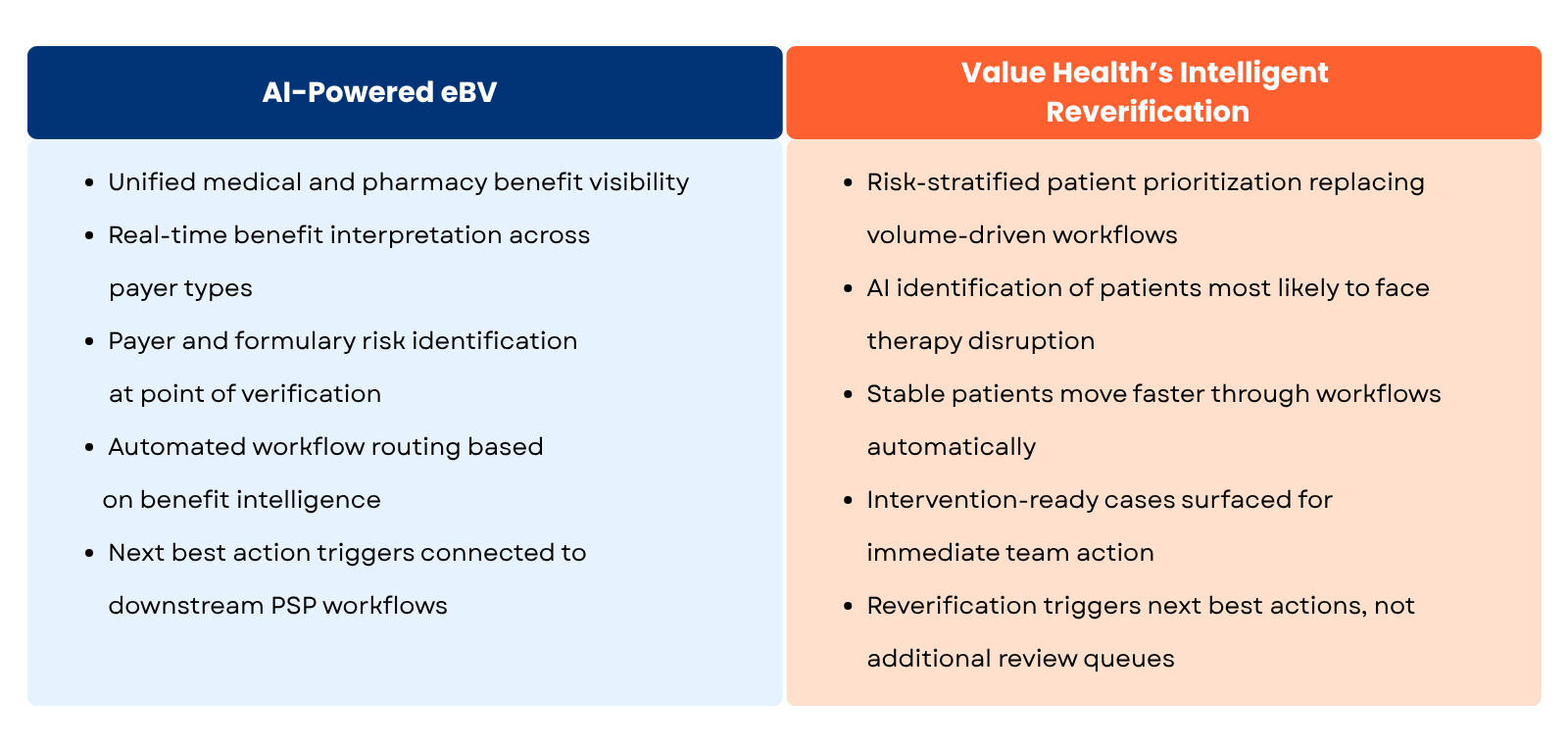
Value Health AI has built a purpose-designed solution that addresses both challenges in an integrated platform. Rather than optimizing verification and reverification as isolated functions, Value Health AI connects benefit intelligence to workflow action across the entire patient support program journey. Learn more and request a consultation at www.valuehealthai.com.
The platform operates across two connected capability sets that together move PSP teams from verification as a task to verification as a workflow engine:
From Isolated Tasks to Connected Workflow Intelligence
The operational shift that Value Health AI enables becomes clear when you see the workflow difference side by side.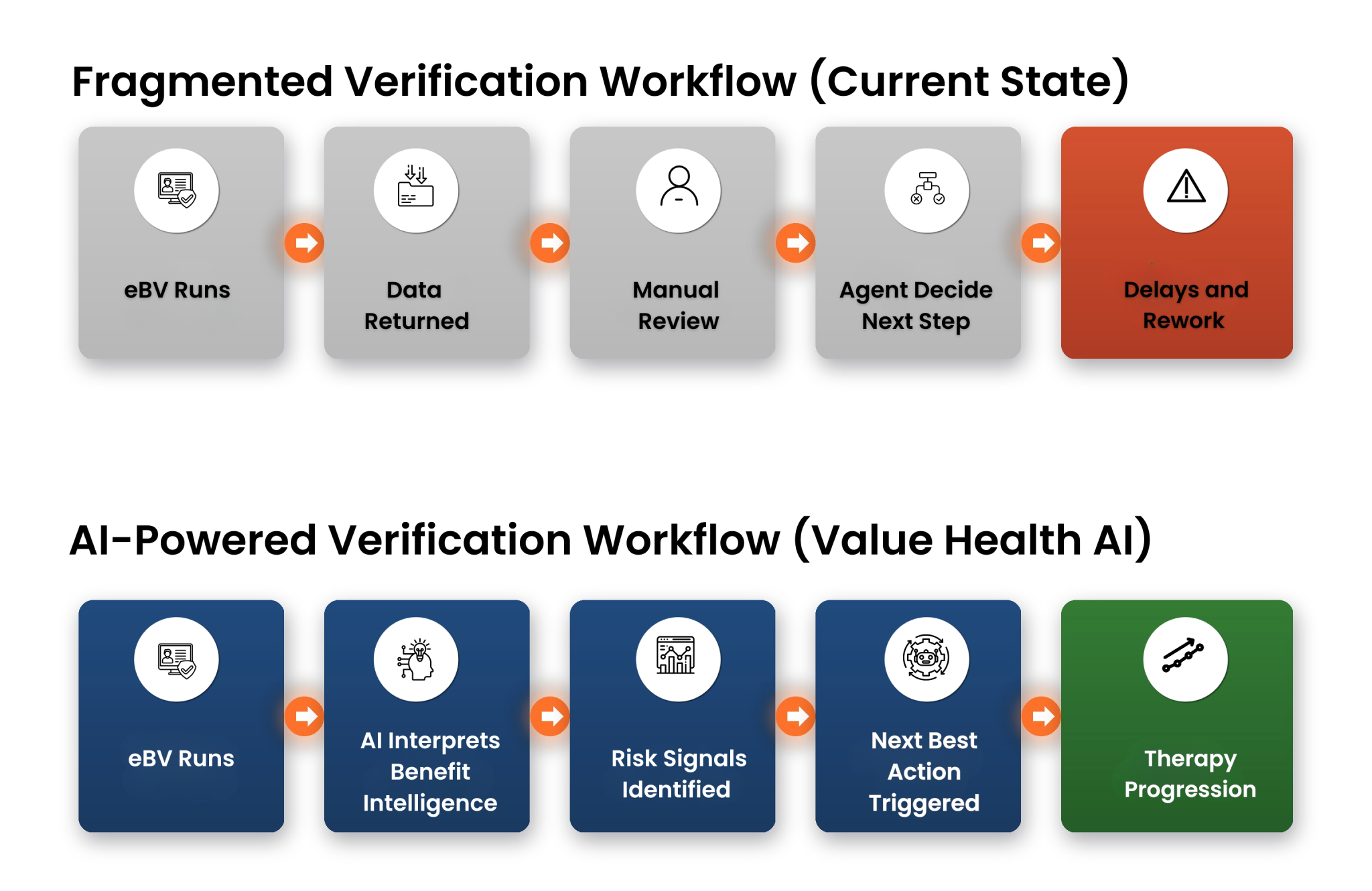
What Smarter Verification and Reverification Mean for PSP Programs
When benefit verification and reverification operate as workflow intelligence rather than isolated tasks, the impact is measurable across every dimension of PSP performance: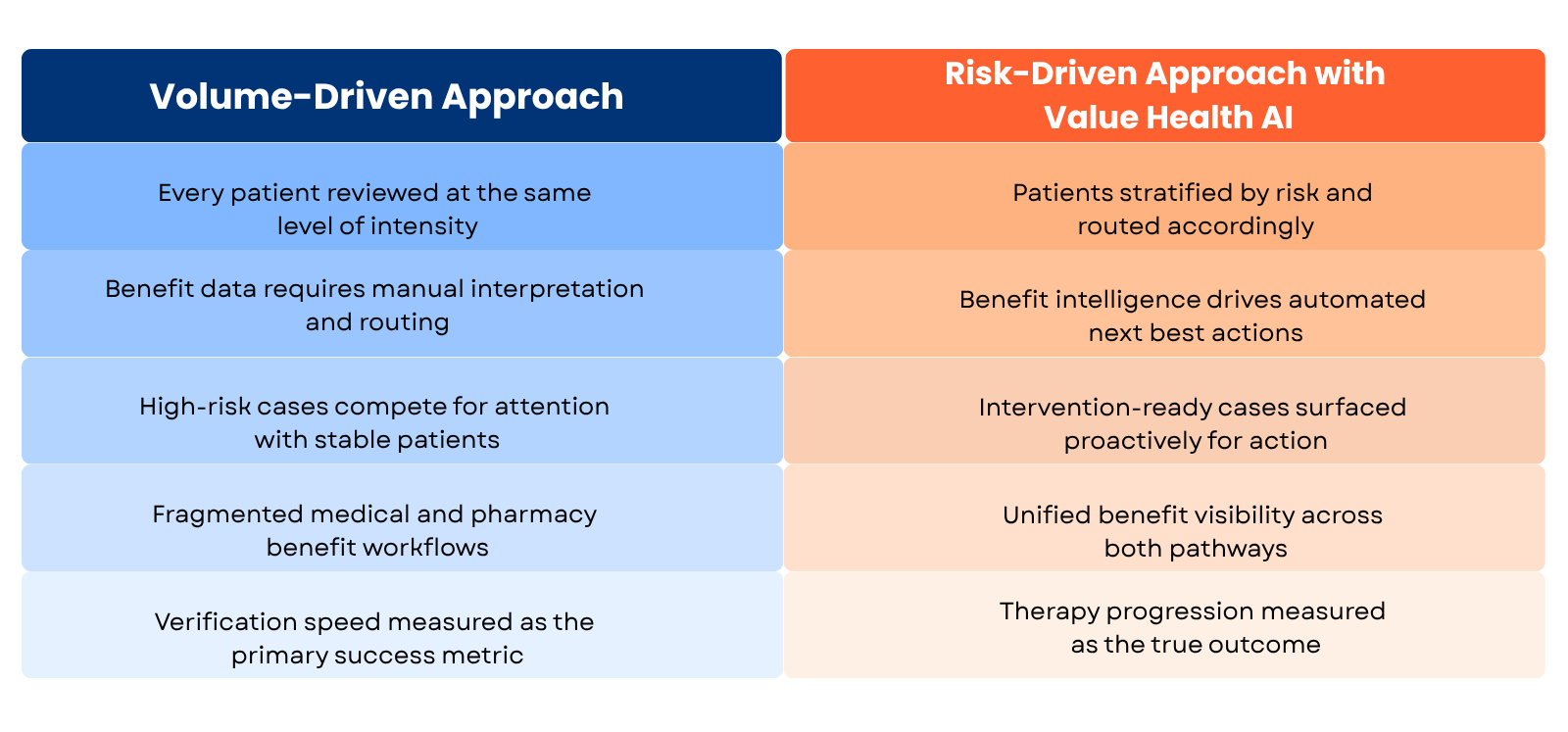
Purpose-Built for Life Sciences. Designed to Move Patients Forward.
At Value Health, we believe that benefit verification and reverification should be measured by one outcome: whether patients reach and remain on therapy. Every workflow decision, every automation, and every AI capability we build is oriented toward that single goal.
Our platform does not treat verification as a checkbox or reverification as an annual burden. We treat them as the most operationally consequential moments in a patient’s support program journey, and we have built AI-powered intelligence that ensures those moments drive action rather than create noise.
Reverification should identify who needs intervention. Modern eBV should move workflows forward. Value Health AI delivers both, in a single integrated platform purpose-built for the complexity of Life Sciences and patient support.
Ready to Move Beyond Verification and Into Workflow Intelligence?
Visit us at www.valuehealthai.com or contact us at info@valuehealthsol.com
