
How Intelligent Document Intake Automation Accelerates Patient Access to Therapy
Every therapy journey starts with a document. Enrollment forms. Insurance cards. Prior authorization requests. Clinical notes. Consent forms. These are the building blocks of patient access, and in many Patient Services Programs (PSPs), they are also the source of the program’s most persistent operational bottleneck.
In too many PSP environments, intake workflows are still heavily manual. Documents arrive through multiple channels, are reviewed and classified by hand, require repetitive data entry, and often trigger rounds of follow-up calls to collect missing information. By the time a patient case is fully created, valuable days have already been lost, before benefit verification even begins.
This white paper examines the true cost of manual intake in Patient Services Programs, the industry realities driving the need for change, and how Value Health AI’s purpose-built Document Intake Automation solution is transforming intake operations from a bottleneck into a competitive advantage.
The Operational Challenge Behind Patient Intake
Patient intake teams in PSP environments operate under significant pressure. They manage high document volumes across multiple intake channels, often simultaneously, while maintaining accuracy standards that directly affect downstream program workflows. The manual nature of these processes creates compounding inefficiencies at every step.
Common intake challenges PSP teams face every day include:
- High document volumes arriving continuously across email, fax, portals, and PDFs
- Multiple intake channels with no unified processing workflow
- Manual validation and indexing requiring significant staff time and expertise
- Repetitive data entry across disconnected CRM and PSP platforms
- Follow-up calls for missing information that delay case creation and frustrate callers
- Fragmented document review workflows with limited visibility into intake status
These delays do not stay contained to the intake function. They ripple downstream, directly impacting the PSP workflows that determine when a patient can begin therapy:
- Benefit Verification (BV) cannot begin without complete intake
- Prior Authorization (PA) submissions are delayed by missing clinical documentation
- Financial Assistance workflows stall when enrollment data is incomplete
- Therapy onboarding timelines extend with every intake delay
- Time-to-Therapy metrics, a critical measure of PSP performance, suffer as a result
The Cost of Manual Intake: A Closer Look
The operational impact of manual intake is significant and measurable. The table below maps the most common PSP intake challenges to their downstream consequences: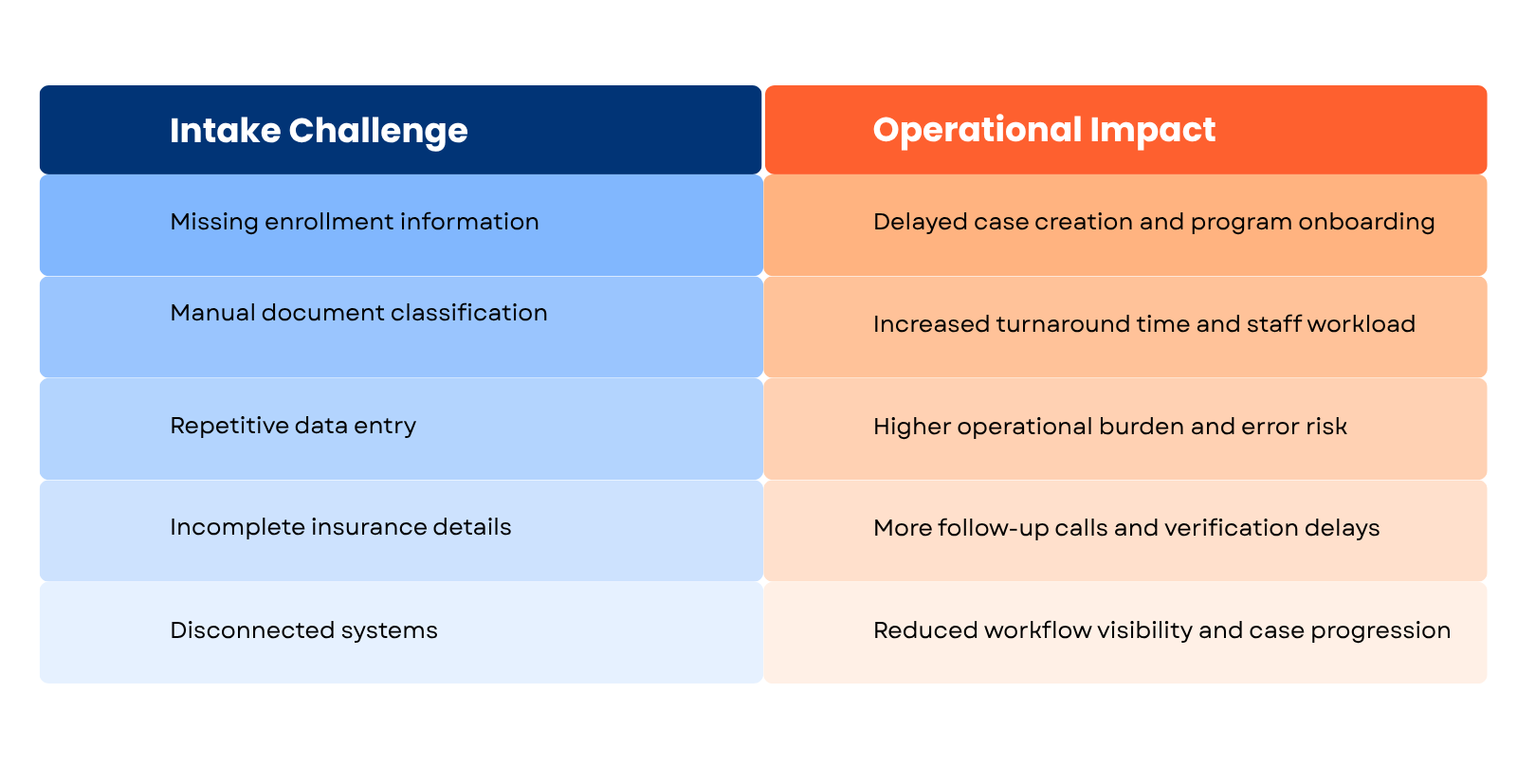
The cumulative effect is a patient intake function that consumes disproportionate staff time, generates preventable rework, and adds days to a process that directly determines when a patient receives access to the therapy they need.
Industry Reality: The Data Behind the Bottleneck
These are not isolated challenges unique to individual programs. They reflect systemic conditions across the PSP industry that make the case for intelligent automation compelling and urgent:
Up to 35% of healthcare staff time is spent on administrative tasks, including document handling and data entry.
1% to 5% manual data entry error rates, depending on workflow complexity, are common in healthcare intake environments.
Multiple channels most PSP teams still receive intake documents across email, fax, portals, and PDFs with no unified processing workflow.
Direct impact delays in intake and verification directly affect therapy initiation timelines, making intake speed a key driver of patient outcomes.
The picture these data points paint is clear. Manual intake is not simply an inconvenience. It is a structural constraint on the performance of Patient Services Programs, and on the patients they exist to serve.
From Document Extraction to Intake Intelligence
Many PSP organizations have implemented some form of optical character recognition (OCR) technology to digitize documents. While OCR reads healthcare documents, it stops well short of understanding them. It extracts text but cannot determine context, intent, or the actions a document should trigger.
Value Health AI has built a solution that goes substantially further. Value Health AI Document Intake Automation understands healthcare documents at a level that drives real operational change: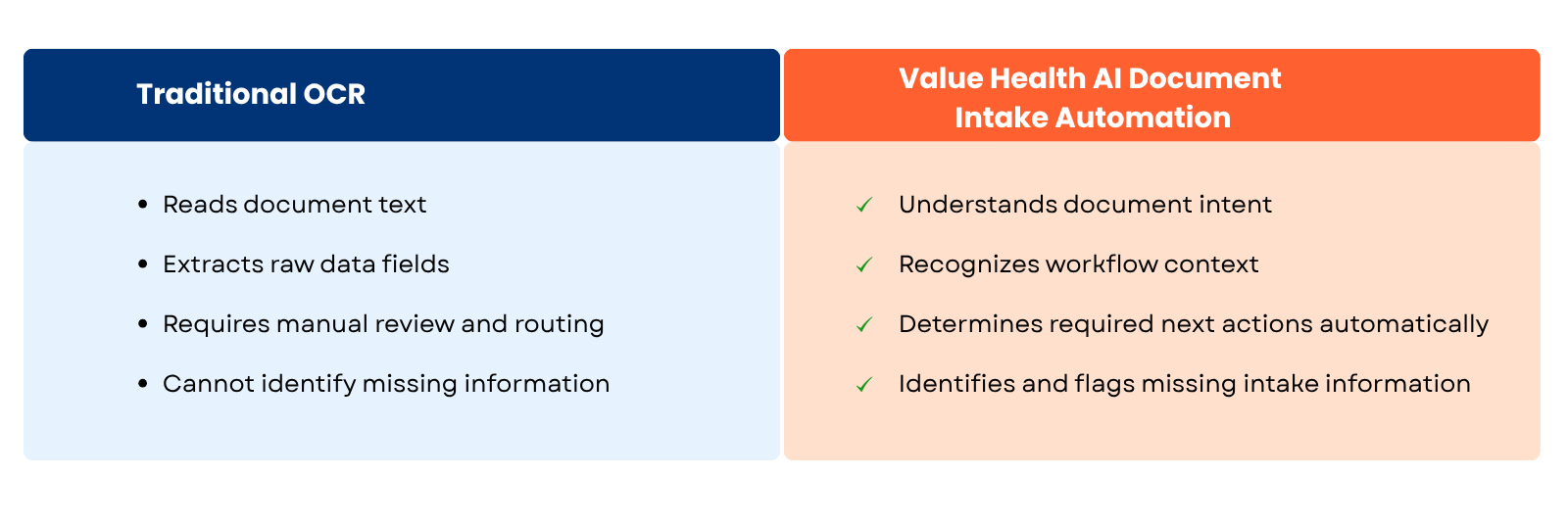
This is the shift from document processing to intelligent intake automation, and it represents a fundamental change in what is operationally possible for PSP teams.
Value Health AI Has a Solution: Document Intake Automation
Value Health AI has built and launched a purpose-designed Document Intake Automation solution for Patient Services Programs. You can learn more and request a consultation at www.valuehealthai.com. The solution is purpose-built for the complexity of Life Sciences intake workflows and operates across five core capabilities:
- Faster Intake Workflows: Automatically classifies and organizes intake documents across program workflows, eliminating manual sorting and routing.
- Intelligent Data Extraction: Extracts patient, payer, provider, and therapy-related information with contextual understanding that goes beyond simple field recognition.
- Reduced Manual Review: Minimizes repetitive validation and indexing tasks for intake teams, freeing staff to focus on exceptions and complex cases.
- Workflow Visibility: Provides operational insight into intake status, pending information gaps, and case progression across the program.
- Faster Case Creation: Accelerates patient onboarding and downstream PSP workflows by ensuring complete, accurate intake data reaches the right teams faster.
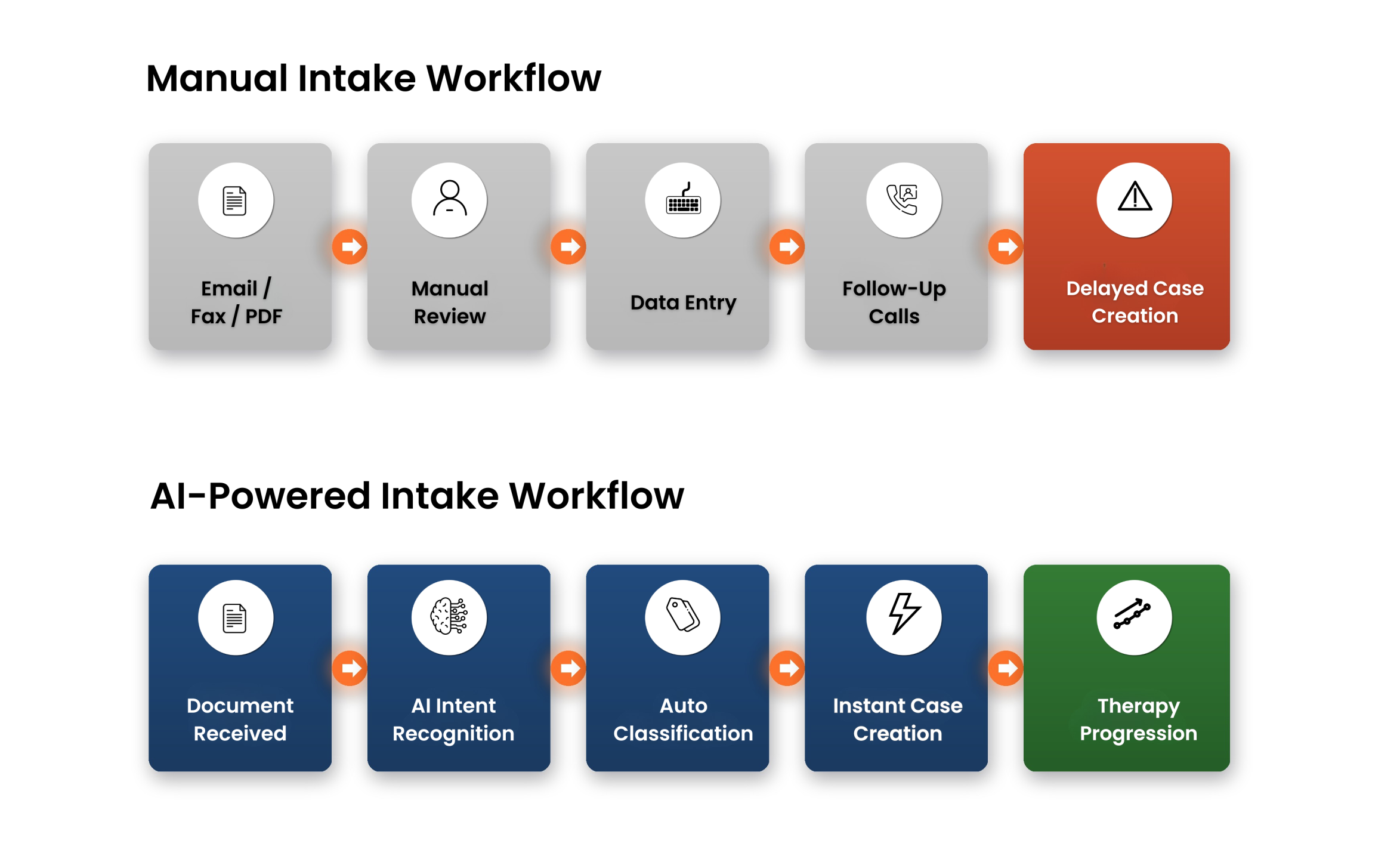
From Manual Chaos to Intelligent Intake: The Workflow Shift
The operational difference between manual and AI-powered intake becomes clear when you see the two workflows side by side.
What Better Intake Operations Mean for Patient Services Programs
When intake intelligence improves, the benefits extend across the entire patient support program ecosystem. PSP teams that implement Value Health AI Document Intake Automation position themselves to deliver: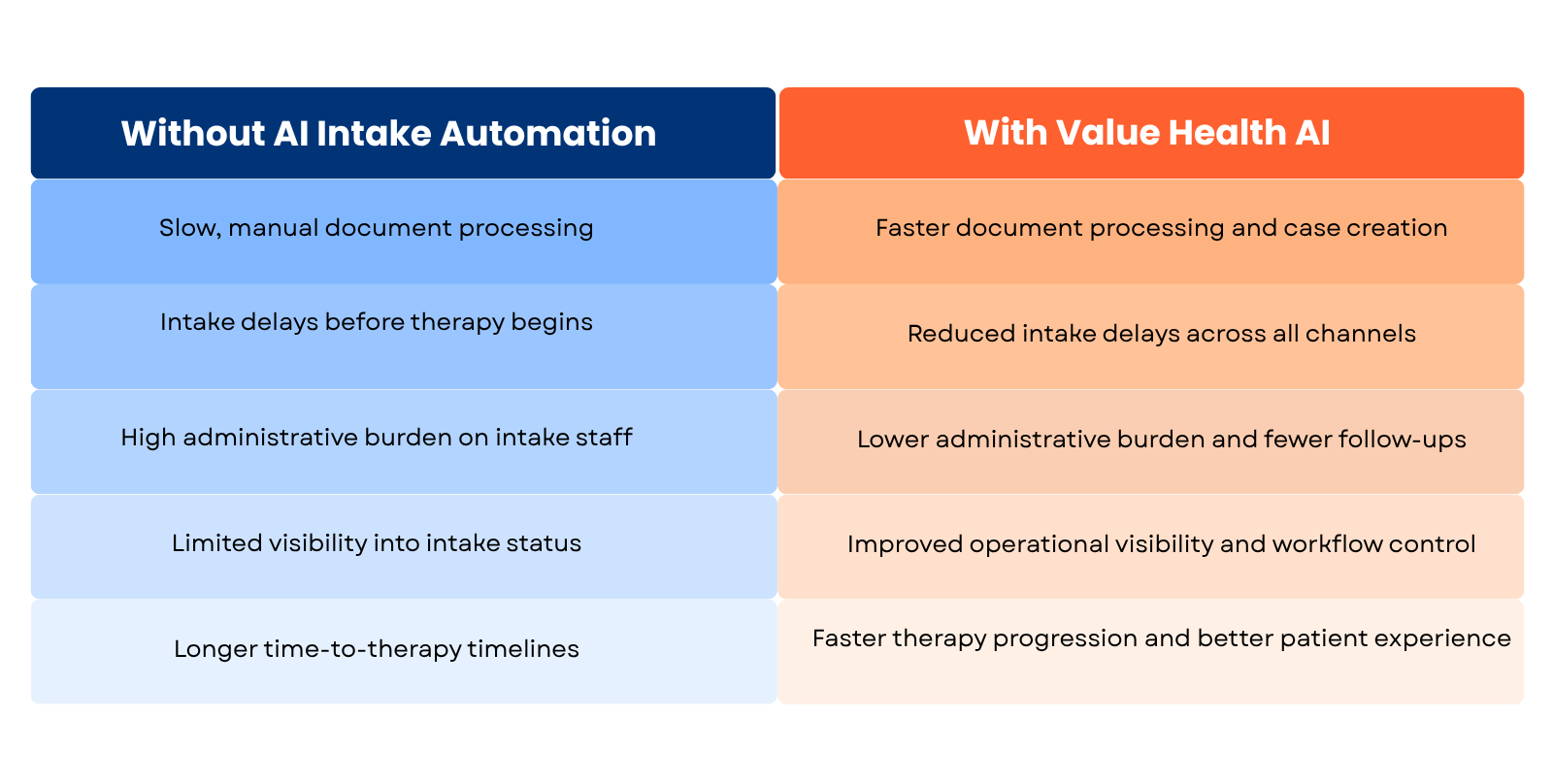
Purpose-Built for Life Sciences. Committed to Patient Outcomes.
At Value Health, we believe the path to better patient outcomes runs through better operations. Document intake may not be visible to patients, but the delays it creates are felt by every patient who waits longer than necessary to begin therapy.
Our AI-powered Document Intake Automation solution is purpose-built for the Life Sciences industry, with deep understanding of PSP workflows, payer documentation requirements, and the operational realities facing hub services, specialty pharmacies, and field teams. It is designed to complement and empower intake teams, not replace them, by automating the high-volume, repetitive, and time-sensitive aspects of document processing so staff can focus on what requires human judgment.
When intake intelligence improves, patient access accelerates. Because therapy delays often begin long before prior authorization. They begin at intake. And that is exactly where Value Health AI can help.
Ready to Eliminate Your Intake Bottleneck?
Connect with Value Health AI to see how Document Intake Automation can accelerate patient access and transform your PSP operations.
Visit us at www.valuehealthai.com or reach out at info@valuehealthsol.com
